
Best American Proxy in 2026: US IP Quality, Speed, and Use Cases Сompared



The best US proxy provider is not always the one with the largest advertised pool on its homepage. For scraping, account management, ecommerce monitoring, SERP checks, and regional testing, the real question is simpler: will the proxy return the right US page without constant CAPTCHAs, login checks, or failed requests?
That is why this comparison looks beyond pool size. We reviewed 6 US proxy providers using public Proxyway data, official provider pages, pricing, proxy type coverage, session controls, and workflow fit.
The article gives more weight to IP quality, US location accuracy, stable sessions, fraud-score signals, and cost per successful request. Pricing and product details were checked in August 2026, but always confirm final availability in the provider dashboard before buying.
Quick Verdict: Best US Proxy Providers by Use Case
If you need a quick answer, here is the shortlist:
| Provider | Best For |
| NodeMaven | Clean US IP quality and stable sessions |
| Oxylabs | Enterprise US scraping infrastructure |
| Bright Data | Large-scale data operations |
| Decodo | General-purpose US residential proxies |
| SOAX | Flexible US targeting controls |
| DataImpulse | Budget US proxy testing |
For workflows with logins, browser profiles, ecommerce monitoring, or protected websites, start with IP quality and session stability. For broad enterprise scraping, large providers with scraper APIs and support may offer more benefits.
How We Ranked the Best US Proxy Providers
This comparison ranks providers by how useful they are for real US proxy workflows, not by advertised pool size alone.
We looked at five factors:
US-specific benchmark data: where available, we used public Proxyway provider reviews to compare observed US residential proxy performance.
IP quality: we considered fraud score, residential detection, and whether the IPs are likely to create CAPTCHAs, login checks, or blocked requests.
Session control: we checked whether the provider supports rotating sessions, sticky sessions, static ISP proxies, SOCKS5, and location targeting.
US workflow fit: we compared how well each provider fits scraping, account management, ecommerce price monitoring, SERP checks, browser profiles, and budget testing.
Pricing and entry cost: we included current public pricing where available, but did not rank the list by cheapest traffic alone.
Important note: Proxyway’s figures show observed US residential proxy performance during testing, not each provider’s full US inventory. Pricing and product claims can change, so confirm details on the provider’s website before buying.
How to Read US Proxy Benchmark Data
Observed US IPs
Observed US IPs show how many unique US residential addresses appeared during a test.
This helps estimate usable US coverage, but it should not be treated as the provider’s full US pool size. A provider may have more inventory than the test observed, and daily availability can change.
Residential Percentage
Residential percentage shows how many tested IPs were detected as residential rather than datacenter, VPN, or hosting traffic.
This matters because protected websites may treat hosting and VPN-looking traffic more cautiously. For ecommerce, search, social, and account-based workflows, residential-looking traffic is often safer than server-looking traffic.
You can check any proxy with NodeMaven’s IP lookup tool to see location, ISP, ASN, and connection type before using it in a workflow.
Fraud Score
Fraud score shows how risky an IP looks in fraud and proxy detection systems.
A high-risk IP can cause problems before your scraper, browser profile, or automation tool reaches the actual page. The result may be a CAPTCHA, login check, blocked page, or suspicious-session prompt.
Request Success
Success rate shows how often requests complete successfully during a benchmark.
For scraping, this affects real cost. A cheaper US proxy can become expensive if it creates retries, CAPTCHA solving, or missing records. For browser workflows, poor success rates feel like broken pages, slow dashboards, or unstable sessions.
Response Time
Response time matters for both scraping and normal browsing.
A slow US proxy can make ecommerce pages, dashboards, SERPs, and automation tools feel unreliable even when the IP itself works.
Sticky and Static Sessions
Sticky sessions keep the same IP for a period of time. Static ISP proxies keep one IP for longer-term workflows.
They matter for:
- logins
- shopping carts
- pagination
- location settings
- price monitoring
- account dashboards
- long-running browser sessions
If a site expects the same user to stay in one place, rotating too aggressively can create more problems than it solves.
Best US Proxy Providers in 2026
1. NodeMaven: Best for Clean US IPs and Stable Sessions
Why It Ranks Here
NodeMaven ranks first because this comparison prioritises clean US IP quality, low fraud signals, sticky sessions, and stable access.
It is a strong fit when the workflow involves:
- US account management
- browser profiles
- ecommerce research
- price monitoring
- web scraping
- regional testing
- workflows where CAPTCHAs and IP reputation matter
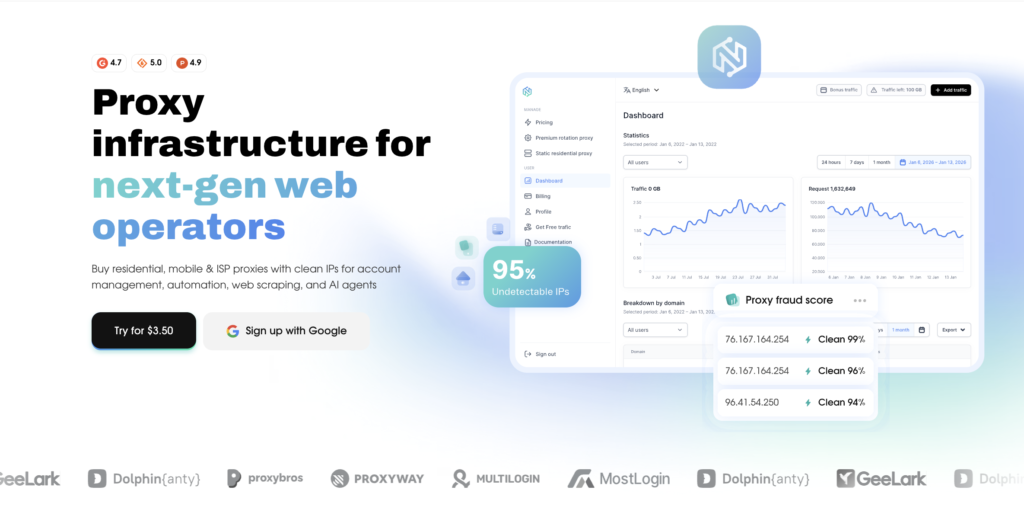
NodeMaven’s residential proxies page lists residential and mobile IPs across 190+ countries, with geo-targeting, sticky sessions, custom rotation, HTTP and SOCKS5 support, live usage statistics, traffic rollover, quality guarantee, and cashback.
US Proxy Product Info and Pricing
Residential and Mobile in one plan: from $2.20/GB
ISP: from $2.33/IP/30 days
Trial: 750 MB for $3.50
US proxy types: residential, mobile, ISP
Public Benchmark Data
In the Proxyway NodeMaven review, Proxyway observed 299,783 unique US residential IPs, 98.37% residential composition, 99.21% US infrastructure success rate, and 0.71 s average US response time.
The same review also tested Scamalytics fraud scores for US IPs and found that NodeMaven’s IP Quality Filter reduced the average fraud score from 10.94 to 4.4 in that test.
In Proxyway Market Research, the US pool IPQualityScore table lists NodeMaven with the lowest fraud score among tested providers: 27.32/100, compared with the average of 58.60/100.
Best Use Cases
- Use NodeMaven rotating residential proxies for ZIP-level targeting, broad scraping and independent page requests.
- Use ISP proxies for static US sessions, long-running monitoring, and account workflows.
- Use mobile proxies when the workflow benefits from carrier-network traffic.
For account-sensitive work, NodeMaven’s strongest angle is simple: cleaner IPs and more stable sessions before scaling traffic.
Where It May Not Fit
NodeMaven may not be the first choice if the only goal is the cheapest possible bulk traffic or a fully managed scraping API.
It is a better fit for users who care about IP quality, fraud score, stable sessions, and predictable access.

Use NodeMaven residential, ISP, and mobile proxies for US scraping, account management, price monitoring, and regional testing. Start with 750 MB for $3.50
2. Oxylabs: Best Enterprise US Scraping Provider
Why It Ranks Here
Oxylabs is a strong fit for enterprise scraping teams that want proxy infrastructure, scraping APIs, support, and compliance under one provider.
Its residential proxy pricing page lists 175M+ residential IPs, sticky sessions, HTTP(S), HTTP/3, SOCKS5, free geo-targeting, unlimited concurrent sessions, and an average 99.95% success rate claim.
US Proxy Product Info and Pricing
Residential: from $2.5/GB
Mobile: from $3.5/GB
ISP: from $1.2/IP
Datacenter: free trial available, from $0.59/GB or $1.20/IP
US proxy types: residential, mobile, ISP, datacenter
Public Benchmark Data
In the Proxyway Oxylabs review, Proxyway observed 929,067 unique US residential IPs, 96.38% residential composition, 99.40% US infrastructure success rate, and 0.65 s average US response time.
Oxylabs had one of the largest observed US pools in this comparison.
Best Use Cases
Oxylabs fits:
- enterprise scraping
- SERP monitoring
- ecommerce data collection
- review monitoring
- large teams
- managed scraping infrastructure
It is especially useful when proxy infrastructure is only one part of a larger data collection stack.
Where It May Not Fit
Oxylabs may be too heavy for small tests or users who only need a simple US proxy server.
The entry cost and product depth make more sense once a team already knows it needs enterprise-grade infrastructure.
3. Bright Data: Best for Large-Scale Data Operations
Why It Ranks Here
Bright Data is built for large data operations. It offers proxy networks, datasets, scraping browser tools, unlocker products, and enterprise controls.
Its residential proxy pricing page lists 400M+ rotating residential IPs across 195 countries, with country, state, city, and ZIP-code targeting.
US Proxy Product Info and Pricing
Residential: from $2.50/GB with current listed promotion
Dedicated ISP/static residential: from $2.5/IP
Datacenter: from $0.42/GB or $0.90/IP
US proxy types: residential, ISP/static residential, datacenter
Public Benchmark Data
In the Proxyway Bright Data review, Proxyway observed 392,272 unique US residential IPs, 99.05% residential composition, 99.14% US infrastructure success rate, and 1.00s average US response time.
The same review lists Bright Data’s US pool fraud score as 71.76/100 in its IPQualityScore data.
Best Use Cases
Bright Data fits:
- large scraping teams
- ready datasets
- unlocker workflows
- advanced scraping browser setups
- compliance-heavy operations
- enterprise data infrastructure
It is a strong choice when a team needs more than raw proxies.
Where It May Not Fit
Bright Data can be complex for users who only need a small US proxy test, browser profile, or simple scraping workflow.
It also has more product layers than many smaller teams need.
4. Decodo: Best General-Purpose US Residential Proxy
Why It Ranks Here
Decodo is a strong all-rounder for users who want broad residential coverage, flexible sessions, and a simpler setup than enterprise-heavy platforms.
Its residential proxies page lists IPs in 195+ locations, HTTP(S) and SOCKS5 support, rotating and sticky sessions, ZIP-code targeting, and uptime/success-rate claims.
US Proxy Product Info and Pricing
Residential: from $2/GB
Mobile: from $2.25/GB
Dedicated ISP/static residential: from $2.5/IP
Datacenter: from $0.02/IP
Trial: 3-day/100 MB trial
US proxy types: residential, mobile, ISP/static residential, datacenter
Public Benchmark Data
In the Proxyway Decodo review, Proxyway observed 961,218 unique US residential IPs, 97.08% residential composition, 99.32% US infrastructure success rate, and 0.75 s average US response time.
That gives Decodo one of the strongest observed US residential pool results among providers in this article.
Best Use Cases
Decodo fits:
- general web scraping
- ecommerce pages
- SEO checks
- regional research
- broad US residential coverage
It is a practical option when users want a balanced provider with many proxy types and a less enterprise-heavy buying flow.
Where It May Not Fit
Decodo is less focused on the “lowest fraud score” angle and more of a broad general-purpose option.
If the main goal is account-sensitive work with the cleanest possible starting IP quality, NodeMaven may be a better workflow fit.
5. SOAX: Best for Flexible US Targeting
Why It Ranks Here
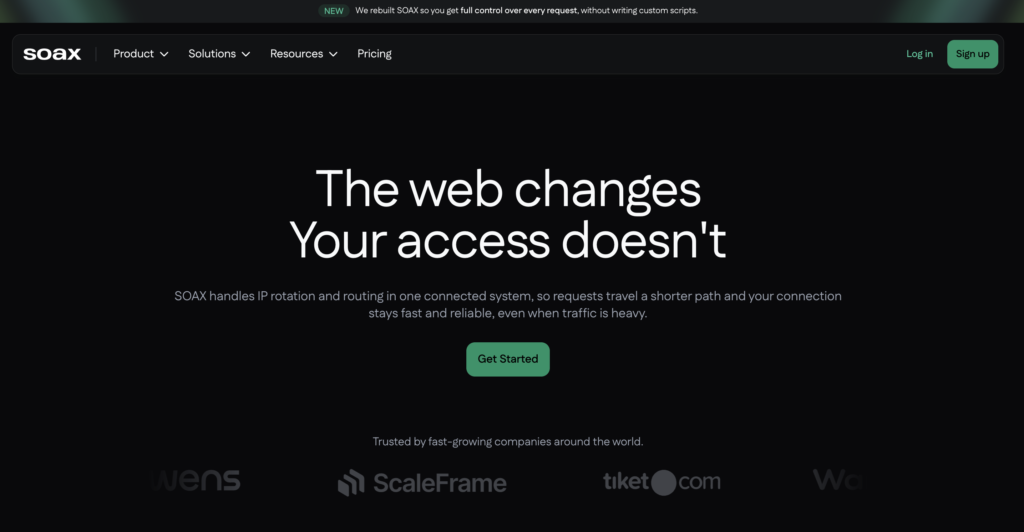
SOAX is useful when users want flexible targeting, rotation controls, and dashboard-level filtering.
The SOAX US proxies page lists American residential, mobile, and US datacenter proxies, with targeting by region, city, or carrier in the United States.
US Proxy Product Info and Pricing
Residential and mobile are bundled in SOAX plans.
Residential and mobile in one plan: from $5.00/GB
Test package: $1.99 for 400 MB / 3 days
US proxy types: residential, mobile
Public Benchmark Data
In the Proxyway SOAX review, Proxyway observed 340,126 unique US residential IPs, 99.07% residential composition, 98.25% US infrastructure success rate, and 0.55 s average US response time.
In Proxyway Market Research 2024, SOAX had a US pool fraud score of 40.88/100.
Best Use Cases
SOAX fits:
- US regional checks
- controlled scraping
- browser workflows
- city or ASN targeting
- flexible rotation rules
SOAX is especially useful when targeting controls matter more than the simplest possible setup.
Where It May Not Fit
SOAX may be more setup-heavy than needed for a basic US proxy test.
It also discontinued its US ISP proxy pool in late 2025, according to Proxyway’s SOAX review. In addition, ZIP-level targeting is not included in smaller plans, so users who need IPs in very specific US locations might consider other providers.
6. DataImpulse: Best Budget US Proxy for Testing
Why It Ranks Here
DataImpulse is useful for budget-conscious users who want to test US proxy workflows before buying more traffic.
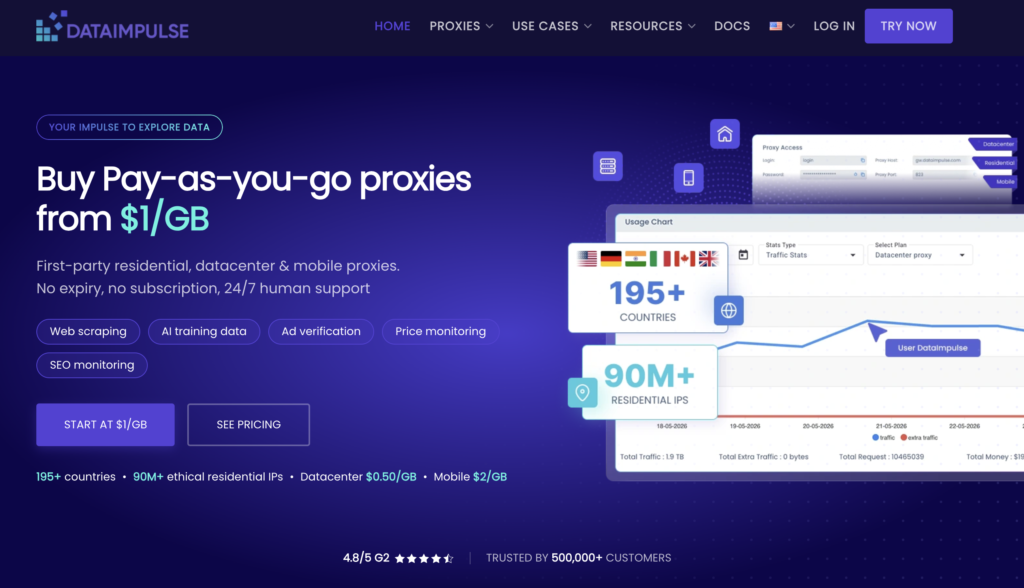
Its residential proxies page lists residential proxies from $1/GB, 90M+ residential IPs, 195 countries, HTTP(S) and SOCKS5 support, rotating sessions, sticky sessions, API access, and free country targeting.
US Proxy Product Info and Pricing
Residential: from $1/GB
Premium residential: from $5/GB
Mobile: from $2/GB
Datacenter: from $0.50/GB
US proxy types: residential, premium residential, mobile, datacenter
Public Benchmark Data
In the Proxyway DataImpulse review, Proxyway separated regular and premium residential pools.
For the US, Proxyway observed:
Regular pool: 352,365 unique US IPs, 86.94% residential composition, 99.44% US success rate, 0.49 s average response time.
Premium pool: 402,322 unique US IPs, 94.93% residential composition, 99.63% US success rate, 0.41 s average response time.
Proxyway also noted that the regular pool had a larger share of non-residential IPs in the US, while the premium pool performed better on composition.
Best Use Cases
DataImpulse fits:
- early scraping projects
- low-cost US traffic testing
- simple target validation
- comparing regular and premium pools
- budget-sensitive proxy users
It is a useful provider when you want to test a workflow cheaply before committing to a larger plan elsewhere.
Where It May Not Fit
DataImpulse is not the safest default for account-sensitive workflows.
It is better as a testing option when budget matters, and the target is not extremely sensitive to IP reputation.
US Residential vs ISP vs Mobile Proxies
Different US proxy types solve different problems. The safest choice depends on whether the workflow needs natural-looking traffic, one stable IP, mobile carrier access, or cheap high-speed testing.
US Residential Proxies
US residential proxies route traffic through IPs associated with real consumer internet connections. They are usually the most practical starting point for scraping public US data from protected websites.
They work well for ecommerce checks, search result testing, market research, regional browsing, and scraping workflows where the target expects normal user traffic. Compared with datacenter IPs, residential IPs are less likely to look like server traffic.
US ISP Proxies
ISP proxies are better when the workflow needs one static US IP instead of rotation.
They fit account management, browser profiles, long-running monitoring, price tracking, and platform access workflows where consistency matters. If the same account or tool should keep a steady US network identity over time, an ISP proxy is usually cleaner than rotating residential traffic.
US Mobile Proxies
Mobile proxies route traffic through mobile carrier networks. They are more specific than residential or ISP proxies and are usually not the first choice for desktop scraping.
They become useful when the target behaves differently for mobile traffic, such as mobile app testing, carrier-specific checks, mobile-first platforms, or ad verification.
Datacenter Proxies
Datacenter proxies are fast and cheap, but they come from hosting infrastructure rather than consumer networks.
They can work well on simple public pages, internal tests, and low-protection targets. For protected ecommerce, social, search, or account workflows, websites may identify hosting networks more easily, so residential or ISP proxies are usually safer.
What Real Scraping Issues Show About Proxy Quality
Anti-Bot Systems Look Beyond the Proxy Alone
A clean proxy helps, but it might not solve every scraping issue by itself.
A Stack Overflow discussion about DataDome blocking shows how anti-bot systems can evaluate the IP address, JavaScript behavior, request details, and browser fingerprint together.
Proxy quality handles the network layer, but browser behaviour, headers, cookies, request timing, and response validation still need to be properly managed.
Datacenter IPs Can Fail Quickly on Protected Targets
Some targets treat datacenter traffic more aggressively than residential traffic.
For example, Apify’s Reddit Scraper documentation says Reddit blocks datacenter IPs and rate-limits single IPs, while residential proxies help keep scraping runs active.
This is why the best proxy server for US scraping is not always the cheapest datacenter option. It depends on the target.
Blocks Can Look Like Successful Requests
A scraper can receive a 200 response and still get bad data.
Apify’s anti-scraping documentation explains that websites may return access-denied pages, CAPTCHAs, redirects, timeouts, empty results, or fake results.
When testing a US proxy, check the actual returned page. Do not rely only on the status code.
Best US Proxy Setup by Workflow
A US proxy setup should match the job. Scraping Zillow listings, checking Amazon prices, opening US search results, and managing a long-running browser profile do not need the same proxy behaviour.
US Web Scraping
For broad US web scraping, start with rotating residential proxies when each page can be requested independently. This works well for public pages, directories, product listings, and search-style results where the scraper does not need to keep one session open.
For example, a Zillow scraper may need US location consistency because real estate pages depend on city, state, neighbourhood, and local listing availability. If you are collecting property data, use residential proxies with the right US location and slower request patterns. NodeMaven’s guide on how to build a Zillow scraper is a useful example.
Craigslist is another good US-specific case. Listings can vary heavily by city, category, and local marketplace. For web scraping Craigslist, use US residential proxies and keep the target city consistent so the scraper does not mix data from different regional pages.
Best setup:
- residential proxies for normal-looking US traffic
- rotation for independent URLs
- sticky sessions for pagination or location-based browsing
- slower request timing for protected or local listing pages
US Ecommerce and Price Monitoring
For US ecommerce, proxy choice affects the data itself. Amazon, Walmart, Best Buy, and other retailers may show different prices, stock status, shipping dates, promotions, and delivery options depending on location, ZIP code, cookies, and session history.
For custom Amazon tracking, use sticky residential sessions or ISP proxies so the price checks come from a consistent US location.
If the workflow checks many independent product pages, rotating residential proxies make sense. If it checks the same products every day from one US region, an ISP proxy or sticky residential session usually gives better results.
Best setup:
- sticky residential proxies for regional product pages
- ISP proxies for stable long-term price monitoring
- ZIP-level targeting when prices or delivery options depend on location
- response validation so CAPTCHA pages are not saved as product data
US Account Management and Browser Profiles
For account management, random rotation is usually the wrong default. A US account that logs in from California, then New York, then Texas in the same day can create unnecessary trust signals.
Use a stable setup instead: one browser profile, one account, one US location, and one sticky or static IP. For long-running accounts, ISP proxies are often the better fit because they provide a static connection. For workflows that need consumer-looking traffic with session control, residential proxies with sticky sessions also work well.
Best setup:
- ISP proxy for stable US account access
- sticky residential session if ISP is not needed
- one browser profile per account
- no random state or city switching during active sessions
US SERP and SEO Checks
US search results change by state, city, device, language, and search history. A keyword checked from Miami may not return the same local pack, ads, map results, or organic rankings as the same keyword checked from Chicago.
For rank tracking and SERP collection, use rotating US residential proxies with precise targeting. For local SEO checks, city or ZIP-level targeting is more useful than generic “United States” routing.
Best setup:
- rotating residential proxies for larger SERP collection
- city or ZIP targeting for local SEO checks
- sticky sessions when checking a sequence of related searches
- separate device/browser profiles for desktop vs mobile SERP testing
US Social, Forums, and Community Data
For platforms like Reddit, social networks, and forums, IP quality matters because these sites often react badly to datacenter traffic, repeated requests, or unnatural browsing patterns.
If the workflow involves public data collection, use clean residential proxies and conservative request behavior. But if the workflow is account-based, keep the proxy location and browser profile stable instead of rotating aggressively.
Best setup:
- residential proxies for public data collection
- sticky sessions for logged-in or stateful browsing
- ISP proxies for long-term account environments
- careful request timing and response checks to avoid collecting block pages instead of real content
How to Test a US Proxy Before Buying More Traffic
Before scaling any US proxy workflow, test a small batch against the actual websites you plan to use.
Check the visible IP first. Confirm the country, state, city, ISP, ASN, and connection type. NodeMaven’s IP lookup tool helps you see whether the IP looks residential, ISP, mobile, datacenter, or VPN-like.
Then test the target website manually. Open several pages, not only the homepage. For scraping, track the CAPTCHA rate, 403s, 429s, timeouts, wrong-region pages, and empty responses.
If the workflow uses logins, carts, location settings, or pagination, test sticky sessions. A proxy that works for one independent request may still fail when the website expects session continuity.
Before buying a larger US proxy plan, use NodeMaven’s proxy bandwidth checker to compare expected traffic with your provider’s reported usage. It helps check whether bandwidth charges look realistic before you scale.
If your tool requires broader protocol support, check whether the provider supports SOCKS5 proxies and HTTP proxies.
Which US Proxy Provider Should You Choose?
For clean US IPs, lower fraud scores, sticky sessions, and stable workflows, NodeMaven is the strongest fit. It works especially well for account management, browser profiles, price monitoring, and scraping workflows where IP quality matters.
Oxylabs makes more sense for teams that need enterprise scraping infrastructure, support, and scraper APIs under one provider.
If the project needs datasets, unlocker tools, scraping browser products, and advanced controls, Bright Data is the better enterprise data-platform option.
Decodo is a good middle-ground provider for broad residential coverage, strong US benchmark results, and a simpler buying flow than heavier enterprise platforms.
Use SOAX when flexible targeting and rotation controls matter more than a minimal setup.
For cheaper US traffic tests before scaling, DataImpulse is the most practical option.
Conclusion
The best US proxy provider is not always the one with the largest advertised pool. For most efficient workflows, the better question is whether the proxy returns the correct US page, avoids unnecessary CAPTCHAs, keeps sessions stable, and gives predictable cost per successful request.
NodeMaven is the strongest fit when US IP quality, session stability, and low-fraud access matter more than raw volume. Oxylabs, Bright Data, and Decodo are stronger for larger infrastructure needs, while SOAX and DataImpulse are useful when targeting flexibility or budget testing is the priority.
Start with a small test, check the IP quality, confirm the US location, and measure success on your real target before buying more traffic.
Use NodeMaven residential, ISP, and mobile proxies for US scraping, account management, price monitoring, and regional testing. Start with 750 MB for $3.50