

Babel Audio Jobs Review: Pay, Requirements, and Worker Experiences


Getting paid to record a conversation sounds like an easy side job. But the recording is only part of the work. Preparing a scene, waiting for another speaker, and redoing a take can eat into your afternoon, leaving you with less per working hour than the advertised rate suggests.
Babel Audio is a real AI data platform offering freelance recording and transcription work. Whether it’s worth your time depends on which project accepts you, what equipment it requires, and how much paid material you can produce.
We’ve already reviewed Pila8, TELUS International AI, and MultiMango, and compared other options in our guide to AI training platforms that pay. This time, we’re looking at Babel Audio: its pay, application process, worker experiences, and the connection setup you’ll need for audio work.
Key takeaways
- Check the pay unit. Babel advertises rates per recorded or transcribed audio hour, which can take you several hours of work.
- Read the individual vacancy. Country, accent, device, microphone, and scheduling requirements differ between projects.
- Expect variable availability. Contributor discussions include successful payouts alongside approval delays, preparation time, and changing project access.
- Choose your connection setup carefully. For work that permits proxies, NodeMaven ISP proxies offer dedicated static IPs in popular locations, like the US, UK, and Germany, with unlimited traffic and UDP support, and keep your connection and IP stable.

For remote-work projects that allow proxies, NodeMaven ISP proxies provide a dedicated static IP, unlimited traffic, and UDP support. Plans start from $2.33/IP/30 days with code ISP25 for new users buying 2+ IPs
What is Babel Audio, and is it legit?
Babel Audio collects human speech and related annotations for AI training. Contributors might record a natural conversation, perform a short scene, or transcribe existing audio. Babel describes its business as building datasets that AI companies license. Its Terms of Use identify David AI Labs, Inc. as the company behind the service.
There is also evidence of actual paid work beyond the company’s own marketing. In a Babel Audio contributor discussion, participants describe receiving payments, completing projects, and adjusting their recording setups. The same thread contains complaints about unpaid preparation and waiting for partners.
However, a legitimate platform can still provide irregular income. Check the offer attached to your own project rather than budgeting around a rate from an advertisement or somebody else’s earnings screenshot.
Apply through the official Babel Audio jobs page. If someone sends you an offer elsewhere, find the corresponding opportunity through the official site before sharing documents or installing software.
What kinds of Babel Audio jobs are available?
The work falls into several formats, and each puts different demands on your time and equipment.
| Job type | What you do | What to check before applying |
| Audio conversations | Talk with another participant about a supplied topic | Language variety, matching windows, device requirements |
| Video conversations | Have a recorded conversation on camera | Accent, lighting, camera performance, computer requirements |
| Voice acting | Perform short scenes with a specified emotion | Improvisation ability, microphone, room acoustics |
| Transcription and annotation | Turn recordings into text and label speech details | Relevant experience, listening accuracy, annotation rules |
For example, Babel’s Portuguese conversation project describes unscripted, 15-minute discussions with another speaker. Its English video project uses five-minute conversations and asks participants to maintain clear video and audio.
Voice acting can be more demanding than reading a paragraph aloud. The Turkish voice-acting vacancy asks for improvised emotional performances in recordings shorter than a minute. That particular listing doesn’t require previous acting experience, but it does require convincing delivery and suitable recording equipment.
How much does Babel Audio pay?
Babel Audio has no single rate that applies to every task and contributor. Public listings use different amounts depending on the task and location. These examples were checked in November 2026:
| Public project | Advertised compensation | Conditions to check |
| Portuguese conversation partner | $17.50 per recorded hour in the US and Canada | Rates elsewhere may be lower |
| English video conversation partner | $35-$50 per recorded hour | US/Canada eligibility; confirm the assigned rate |
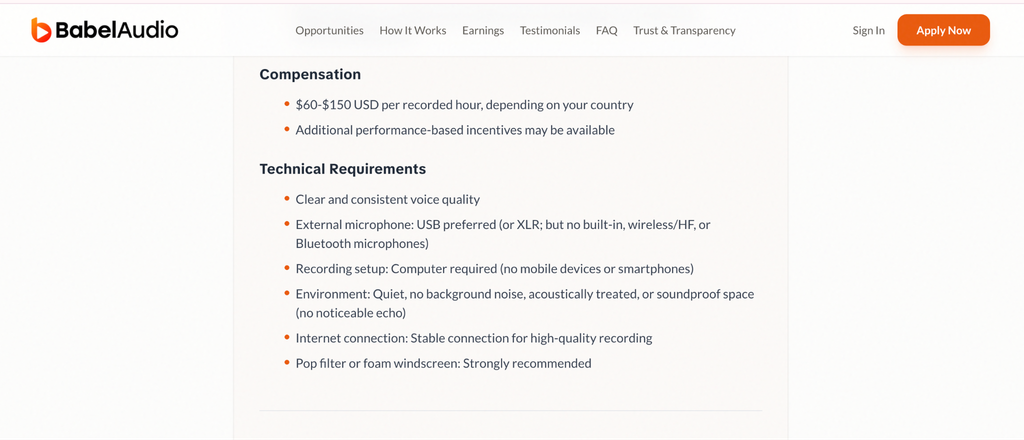
| Turkish voice acting | $60-$150 per recorded hour | Country-based rate, confirmed before recording |
| English transcription | $160 in the headline; $90 in the compensation section | The public page contains conflicting figures |
The transcription discrepancy deserves clarification before you start. The listing also specifies an audio-hour basis, so neither figure should be read as payment for one hour of your work.
Recorded-hour pay versus your actual working time
An hour of accepted recording may involve preparation, retakes, technical checks, or waiting for somebody to join.
As a hypothetical example, suppose a project pays $35 per recorded hour. You finish 30 minutes of accepted material and earn $17.50. If the whole session takes 90 minutes, your effective earnings are $11.67 per working hour, before expenses and taxes.
That distinction is central to the “Not Really $50” discussion. The contributor describes expecting an hourly wage, then discovering how much time fell outside recorded minutes. It is one person’s experience, but it gives you a useful question to ask: how much accepted material can you produce in the time you actually spend?
How do Babel Audio payments work?
Babel advertises weekly Tuesday payouts through Dots, with PayPal, Venmo, and bank transfer among the options. It says there is no minimum payout threshold or platform fee.
Confirm the methods available to your account and distinguish the payment being issued from its arrival at your bank. If something is missing, collect the project name, work period, earnings status, and payout reference before contacting support.
Who can apply, and what equipment do you need?
Start with the vacancy that matches your language and residence. Speaking the required language doesn’t automatically satisfy a location requirement. English video work, for example, targets participants based in the US or Canada and specifies a General American accent.
Equipment rules also change with the task:
- Portuguese conversations: the current listing allows a computer or smartphone and recommends wired headphones. Some everyday background noise is acceptable, but TV, music, and other people talking are excluded.
- English video: a laptop or desktop is required, with a camera capable of at least 720p and 30 FPS. An external or USB microphone is preferred.
- Turkish voice acting: a computer, external microphone, and quiet recording space are required.
- English transcription: a computer and headphones or earphones are specified.
These requirements come from the individual listings linked above. Don’t buy equipment based on a general forum recommendation when your assigned project may have different rules.
The Turkish listing even has inconsistent microphone wording between its language versions: the English section permits XLR, while the Turkish section rejects it. If that affects your setup, confirm the requirement with Babel before purchasing anything.
For remote-work projects that allow proxies, NodeMaven ISP proxies provide a dedicated static IP, unlimited traffic, and UDP support. Plans start from $2.33/IP/30 days with code ISP25 for new users buying 2+ IPs
How to apply, and why an application may stay under review
Babel promotes a short application process, but submitting an application and getting approved are separate steps.
- Open an official vacancy that matches your language, residence, and equipment.
- Follow its application instructions and complete any requested sample.
- Wait for confirmation that you’ve been accepted for a specific project.
- Check the assigned rate, current guidelines, and payout setup before beginning paid work.
In the application-review thread, applicants describe different wait times and a lack of clear updates.
If your application is pending, check your account and email for updates. You can also email [email protected], including the role name and the date you applied.
Common Babel Audio problems
Preparation and partner availability affect earnings
The “Is Babel Audio worth it?” thread includes contributors who enjoy the work and report successful payments. Others describe waiting for a partner, completing checks, and spending time on instructions outside the recording itself.
For paired work, check when matching is available. The current Portuguese listing specifies windows when calls can start, despite the site’s broader flexible-hours messaging. Solo work and transcription have different scheduling demands.
Quality feedback can be difficult to act on
Contributors also describe noise flags, recording checks, and changing daily allowances. A new microphone isn’t always the first useful purchase: inspect the failed criterion and test the setup you already have.
If the problem is echo, try headphones and a less reflective room. If the camera struggles, check its selected resolution and other applications using it. Record the exact error so support can distinguish an equipment issue from a project restriction.
“Removed” can leave contributors unsure what happened
In a roleplay status discussion, participants describe projects appearing as “removed” after they believed the work had ended. Another thread about a raised limit followed by removal includes a reply suggesting that the project had been paused.
Those replies aren’t official explanations. Ask which status changed: the project, your access to it, or the entire account. Save the notification and project name rather than assuming every status change is a ban.
Keep your connection stable during audio work
Recording sessions and file uploads need a reliable connection. If your project permits proxies, a dedicated static IP keeps your public address consistent across repeat sessions in your approved region.
NodeMaven ISP proxies combine high-speed infrastructure with dedicated addresses in the US and selected European countries, including the UK and Germany. Unlimited traffic lets you upload recordings without consuming a per-GB proxy allowance, while the address remains assigned for your purchased period.
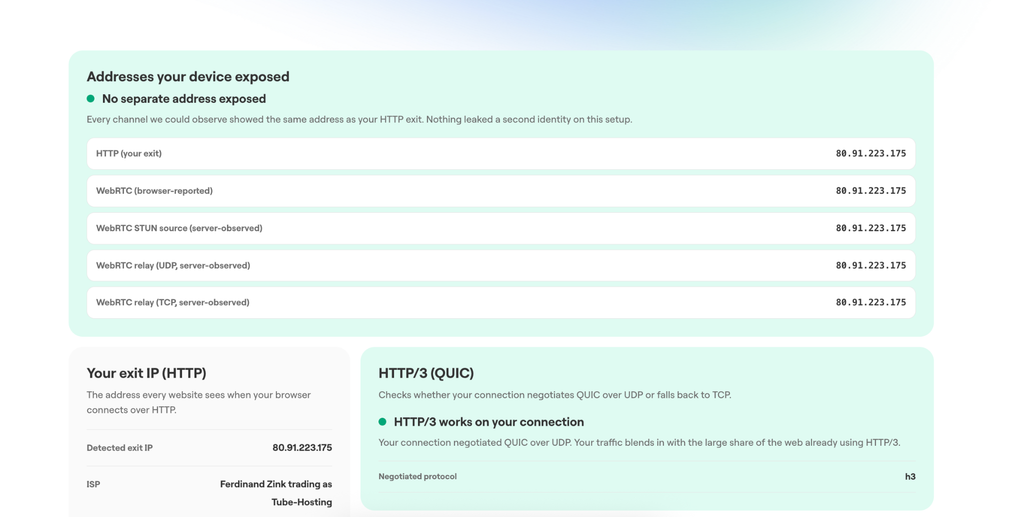
Audio and video calls may also use UDP through WebRTC. NodeMaven ISP proxies support both TCP and UDP, but your browser or proxy client must route that traffic correctly. A working dashboard alone doesn’t confirm that the call connection uses the same route.
To set up your proxy, follow the instructions for your browser or app in NodeMaven’s integration guides. For easy browser setup and switching between profiles, use a proxy manager extension as shown in our Chrome proxy configuration guide. For application-level routing, see the Happ setup guide or Proxifier integration.
Always check your setup with the NodeMaven Connection Checker before starting work: confirm the expected proxy IP and inspect the WebRTC results for any exposure of your real public address. Repeat the check after changing profiles or routing settings.
For remote-work projects that allow proxies, NodeMaven ISP proxies provide a dedicated static IP, unlimited traffic, and UDP support. Plans start from $2.33/IP/30 days with code ISP25 for new users buying 2+ IPs
What happens to your voice recordings?
Recording work involves giving the platform material for AI development. Babel’s privacy policy covers sensory data such as audio and video, alongside account, payment, device, and location information.
Its terms grant a broad license over submissions, including rights to modify, distribute, and sublicense them. The license continues after account termination. Read the project-specific consent before recording your voice, face, or surroundings, and ask about any use you aren’t comfortable accepting.
Don’t assume closing an account automatically withdraws previously licensed recordings. Keep a copy of the terms and consent attached to the project you join.
Is Babel Audio worth joining?
Babel Audio is worth evaluating if you qualify for an active project, have suitable equipment, and can treat the earnings as supplementary. Before investing in new hardware, confirm your assigned rate and find out whether the available work justifies the expense and your time.
Related platforms offer different routes into AI work. Our Pila8 review covers another audio-data platform, while the TELUS International AI review explains broader evaluation and contributor roles. The MultiMango review covers a task interface that contributors may access through another research organization.
For your first sessions, track accepted work, total time, and payment progress. If the project permits proxies and you need a persistent work address, choose a dedicated ISP setup with the required protocol support, then check it before a long session. Spend on a better connection when it addresses an identified problem, with the project’s rules settled first.


