
Datacenter Proxies: What They Are, How They Work, and When to Use Them



Datacenter proxies are usually the first option people look at when they need fast proxies at a lower price.
And in some cases, they do the job well. They can be useful for basic scraping, SEO checks, testing, or other tasks where speed matters more than IP origin.
But once the workflow becomes more sensitive, the downsides start to show. Most websites can recognise datacenter IPs more easily, sessions may be less stable, and success rates can vary depending on the provider and IP history.
This guide breaks down how datacenter proxies work, where they fit, and how they compare with residential and ISP proxies. We’ll also look at when ISP proxies are the better option for users who need fast static IPs, stronger trust, and more consistent long-term performance.
What are datacenter proxies?
A datacenter proxy is a proxy IP hosted on server infrastructure rather than assigned to a real household connection or mobile carrier. In most cases, these IPs come from hosting companies, cloud providers, or datacenter networks.
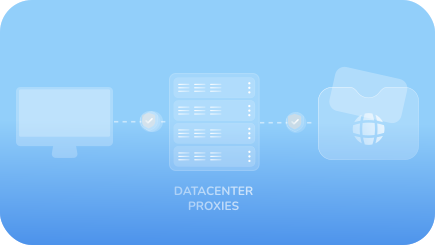
It works like any other proxy: your request goes through the proxy server first, and the website sees the datacenter proxy IP instead of your original IP address.
The main difference is the IP source. Residential proxies use ISP-assigned household IPs, mobile proxies use carrier network IPs, and datacenter proxies use server-hosted IPs.
This is why datacenter proxies are usually fast, affordable, and easy to scale. At the same time, they can be easier to identify as non-residential traffic, which makes them less suitable for workflows where IP trust and session consistency matter more.

Try high-quality ISP proxies from $2.33/IP/30 days as a datacenter alternative with static residential IPs, unlimited traffic, and long sessions built for stable workflows
How do datacenter proxies work?
Datacenter proxies sit between your device or tool and the website you’re trying to reach.
You send a request to the proxy first. The proxy passes it to the website using a datacenter IP address. The website then sends the response back to that proxy, and the proxy returns it to you.
Datacenter IPs run on server infrastructure, so they often have unmetered bandwidth, stable hardware, and low-latency in many locations.
But that does not always mean the workflow is fast. If the IPs are overused, flagged, or have a high-fraud score, you may spend more time dealing with failed requests, retries, and unstable sessions than actually completing the task.
Types of datacenter proxies
Datacenter proxies differ by access type, session behavior, and IP version. Each option has tradeoffs, especially around cost, reputation, and success rates.
Shared datacenter proxies
Shared datacenter proxies use the same IP pool across multiple users.
They are cheaper, but the risk is higher. If other users overuse or spam the same IPs, reputation drops, fraud scores increase, and success rates can become unstable.
Best for: Basic testing or low-risk tasks
Dedicated datacenter proxies
Dedicated datacenter proxies are assigned to one user.
They give you more control and usually perform better than shared IPs. But they are still datacenter IPs, so websites can often classify them as server-hosted traffic.
Best for: Users who need more consistency but do not need high-trust IPs
Static datacenter proxies
Static datacenter proxies keep the same IP over time.
A datacenter static proxy can help when you need a consistent session, but only if the IP has a clean reputation. A static IP with a poor history can still cause failed requests. The good alternative might be an ISP proxy.
Best for: Simple workflows that need one stable IP
Rotating datacenter proxies
Rotating datacenter proxies change IPs by request or time interval.
They can help with broader data collection, but rotation does not always fix reputation issues. If the pool is heavily reused, many IPs may still perform poorly. As a solution for better quality, rotating residential proxies can be used.
Best for: High-volume tasks where IP trust is less important
IPv4 and IPv6 datacenter proxies
IPv4 and IPv6 are not separate proxy types. They refer to the IP version used by the datacenter proxy.
IPv4 datacenter proxies are still the more common choice because most websites, browsers, and tools support IPv4 by default.
So, what is a IPv6 datacenter proxy? It is simply a datacenter proxy that uses an IPv6 address instead of IPv4. IPv6 can be cheaper and available in larger supply, but compatibility depends on the target website, browser, or automation tool.
Common use cases for datacenter proxies
Datacenter proxies are usually used when speed, scale, and low upfront cost matter most. They can work for simple tasks, but often become less efficient when IP trust, clean reputation, or stable sessions matter.
Public web-scraping
Datacenter proxies can collect public data at scale, especially from websites with simple access rules.
For more complex targets, they may cause more failed requests because datacenter IPs are easier to classify and block. Residential proxies or ISP proxies are usually better for higher success rates and more efficient scraping.
SEO tracking
Common SEO use cases include:
- rank tracking
- SERP checks
- keyword monitoring
- technical SEO checks
Datacenter proxies can work for quick checks, but poor IP reputation may make results unstable. For city-level SEO tracking, residential proxies are often a better option because they offer more precise geo-targeting across countries, cities, ZIP codes, and ISPs. For repeat checks from the same static IP, ISP proxies can be useful too.
Price monitoring
Datacenter proxies can support:
- e-commerce price tracking
- travel fare checks
- competitor price research
- market availability monitoring
Website and app testing
Datacenter proxies can help with localization testing, load testing, QA workflows, and checking how pages behave across regions.
For realistic regional testing, residential proxies or mobile proxies are stronger. For repeatable tests from the same static IP, ISP proxies are a better fit.
Automation workflows
Datacenter proxies can handle simple automated tasks.
For always-on automation, ISP proxies are often the better option because they provide static high-trust identity, low fraud score, fast performance, and longer session consistency.

Benefits of datacenter proxies
Datacenter proxies still have a few clear advantages, mainly around speed, price, and availability.
- Fast connection speeds
Datacenter proxies usually run on strong server infrastructure, so they can be fast and responsive. They work best for speed-sensitive tasks where IP origin does not matter much.
- Lower pricing
Datacenter proxies are usually cheaper than residential and mobile proxies. This can be useful when you need many IPs at a lower upfront cost. The tradeoff is quality. Cheap datacenter pools often come with weaker IP reputation, higher fraud scores, and lower success rates.
- Easy availability
Datacenter proxies are easy to find and simple to set up. Most providers offer them in different formats, including shared, dedicated, static, and rotating IPs.
- Good for simple high-volume tasks
Datacenter proxies can work well when websites do not closely evaluate the IP source. They are best for simple tasks where speed and cost matter more than trust level, session stability, or long-term efficiency.
Limitations of datacenter proxies
Datacenter proxies can be fast and cheap, but weak IP quality often creates extra work: failed requests, retries, and unstable sessions.
- Datacenter IPs are easier to classify
Many websites can spot hosting or cloud IP ranges. Because of that, datacenter IPs may look less like normal user traffic. On sensitive platforms, this can mean more failed requests and lower success rates.
- Reputation can vary by provider
Cheap datacenter pools are often heavily reused. Some IPs may already have poor history, high fraud scores, or spam-like activity. If the same subnet is overused, performance can drop fast.
- Location targeting may be limited
Datacenter proxies often support country-level targeting. But city, ZIP, carrier, or ISP-level targeting is usually weaker than with residential proxies. That makes them less useful for local SEO, regional testing, or location-specific data.
- Long sessions may be less reliable
Static datacenter proxies can keep the same IP. But a stable IP is not always a trusted IP. For long-term account workflows, ISP proxies are usually stronger because they offer static residential identity and better session consistency.
- Not always ideal for sensitive workflows
Some websites check the datacenter traffic more strictly. When IP quality and identity consistency matter, residential, mobile, or ISP proxies are often more efficient in the long run.
Try high-quality ISP proxies from $2.33/IP/30 days as a datacenter alternative with static residential IPs, unlimited traffic, and long sessions built for stable workflows
Datacenter vs residential vs ISP proxies
The main difference between datacenter, residential, and ISP proxies is where the IP comes from. That source affects speed, trust level, session stability, targeting, and long-term efficiency.
Datacenter proxies often look cheaper and faster at first, but they can become inefficient if the IPs are overused, flagged, or easy to classify. Residential and ISP proxies usually perform better when success rate, clean reputation, and session consistency matter.
| Feature | Datacenter proxies | Residential proxies | ISP proxies |
| IP source | Server-hosted IPs that are easier to identify | Real household IPs that look more natural | Static residential IPs assigned by ISPs |
| Main benefit | Low upfront cost and fast setup | Better trust, rotation, and geo flexibility | Stable identity with high speed |
| Speed | Usually fast, but failed requests can slow the workflow | Fast enough for most data and automation tasks | High speed for long-running workflows |
| Trust level | Lower on sensitive sites, which can lead to more blocks or checks | Higher because IPs look like real user connections | Higher than datacenter IPs, with more consistent sessions |
| Real cost | Can become expensive through retries, failed requests, and IP replacements | Higher upfront cost, but fewer wasted requests | Predictable IP-based pricing with unlimited traffic |
| Rotation | Static or rotating, but often from reused server ranges | Natural IP diversity for scraping and geo-specific tasks | Static IPs for workflows that need one consistent identity |
| Best for | Simple testing, basic scraping, and low-risk high-volume tasks | Market research, SEO tracking, data collection, and geo-targeted workflows | Account workflows, 24/7 automation, e-commerce, and long sessions |
Key difference between datacenter and residential proxies
In a datacenter vs residential proxies comparison, datacenter proxies usually win on raw speed and price. Residential proxies win on trust, geo coverage, and real-world success rates.
A residential proxy uses a real ISP-assigned household IP, which makes it harder to classify as server-hosted traffic. That is why residential proxies are often better for scraping, market research, automation, and geo-specific workflows. Residential proxies are harder to block.
NodeMaven residential proxies use real household IPs, support HTTPS and SOCKS5, offer sticky sessions, and include a quality-focused 30M+ IP pool across 190+ countries.
Key difference between datacenter and ISP proxies
The key difference is IP trust. Datacenter proxies use IPs from hosting or server infrastructure, while ISP proxies use static residential IPs assigned by real ISPs.
That means both can be fast with unlimited traffic, but ISP proxies usually offer a stronger reputation and better long-term session stability.
In simple terms:
- Datacenter proxies are better for basic, high-volume tasks where cost matters most
- ISP proxies are better for stable workflows where clean IPs, consistent identity, and fewer failed requests matter more
So, if you need speed only, datacenter proxies can work. If you need speed plus reliability, ISP proxies are usually the stronger choice.
What makes ISP proxies a better choice
ISP proxies sit between the datacenter and residential proxies.
They are static residential IPs assigned by ISPs but hosted on stable infrastructure. This gives users datacenter-like speed and bandwidth with stronger IP trust and better session consistency.
Compared with datacenter proxies, ISP proxies are usually a better fit when you need:
- long sessions
- stable account identity
- 24/7 automation
- e-commerce workflows
- ticketing and sneaker workflows
- affiliate marketing
- crypto account workflows
NodeMaven ISP proxies are static residential IPs with unlimited traffic, HTTPS and SOCKS5 support, country targeting, quality checks, and pricing from $2.33/IP/30 days.
Try high-quality ISP proxies from $2.33/IP/30 days as a datacenter alternative with static residential IPs, unlimited traffic, and long sessions built for stable workflows
When should you use datacenter proxies?
Datacenter proxies make sense when the job is simple, and the target website does not care much about the IP source.
Use datacenter proxies when speed and cost matter most
They can work for:
- simple public data collection
- basic SEO checks
- internal testing
- low-risk automation
- high-volume tasks on less strict websites
Here, the low price and fast connection can be enough.
Avoid datacenter proxies when IP trust matters
The problems usually start when the workflow depends on clean IPs and stable sessions.
Datacenter proxies are often a poor fit for:
- account-based tasks
- long-running automation
- sensitive platforms
- precise geo-targeting
- workflows where failed requests waste time
In these cases, the cheaper option can become more expensive. You spend more time fixing errors, changing IPs, and repeating tasks. That is where it makes sense to look at other proxy types.
Best alternative to datacenter proxies
There is no single replacement that fits every workflow. It depends on what your use case need: rotation, mobile IP behavior, or one stable IP for long sessions.
ISP proxies for stable, long-running workflows
ISP proxies are usually the closest step up from datacenter proxies, but give you better results and more efficiency.
They still give you fast performance, but the IPs are assigned by real ISPs and stay static. That makes them a better option when you need a consistent identity and fewer session issues.
Best for:
- continuous automation
- account-based workflows
- e-commerce operations
- long sessions
- tasks where one stable IP matters
If you like the speed of datacenter proxies but keep running into trust or stability problems, ISP proxies are usually the better fit.
Residential proxies for scale and rotation
Residential proxies make more sense when you need a large rotating pool and more natural IP diversity.
Because they use real household IPs, they are often better for workflows where datacenter IPs get flagged too quickly or create too many failed requests.
Best for:
- public data collection
- market research
- SEO tracking across cities
- price monitoring
- geo-specific testing
They are also stronger for location-based tasks, especially when you need country, city, ZIP, or ISP-level targeting.
Mobile proxies for mobile-first platforms
Mobile proxies are useful when the workflow depends on mobile network behavior.
They use real mobile carrier IPs, which makes them a better match for mobile-first platforms, apps, and social workflows.
Best for:
- social media workflows
- CPA marketing
- mobile app testing
- crypto workflows
- mobile-first account activity
Try high-quality ISP proxies from $2.33/IP/30 days as a datacenter alternative with static residential IPs, unlimited traffic, and long sessions built for stable workflows
Why NodeMaven gives you more than datacenter proxies
Datacenter proxy can seem like the cheaper choice at first. The problem is what happens after setup. If the IPs are already overused, flagged, or easy to classify, you end up paying with failed requests, retries, unstable sessions, and time spent fixing the workflow.
NodeMaven is built for users who care about the final result, not just the lowest proxy price. You get cleaner, higher-trust proxy options with:
- IP Quality Filter to remove low-quality or high-risk IPs before assignment
- Residential proxies for large-scale rotation, public data collection, and precise geo-targeting
- Mobile proxies for mobile-first platforms, apps, and social workflows
- ISP proxies for static identity, unlimited traffic, and long-running sessions
- Sticky sessions for workflows that need the same IP for longer
- Quality guarantee for extra confidence in proxy performance
- Cashback to get more value from ongoing residential and mobile proxy usage
- 2-in-1 residential and mobile access in one plan
So instead of saving a little on IPs that may create more work later, NodeMaven helps you reduce failed requests, keep sessions stable, and get more value from every workflow.
Final thoughts: are datacenter proxies worth it?
Datacenter proxy can be worth it for basic tasks. They are fast, easy to buy, and usually cheaper than other proxy types.
The issue is reliability. If the IPs are overused or already flagged, the workflow can quickly become messy: failed requests, retries, unstable sessions, and extra time spent changing proxies.
So yes, datacenter proxies can work when the task is simple and IP origin does not matter much.
But for long sessions, account workflows, automation, or anything where failed requests cost time, ISP proxies are usually a better choice. For larger rotating tasks, residential or mobile proxies will often make more sense.