
Alignerr Review 2026: Is It Legit and Does It Pay?



You may have found Alignerr through an AI training job listing, completed its application process, or passed an assessment only to find no available project. Alignerr is a legitimate freelance AI training platform connected to Labelbox, but registration and onboarding do not guarantee paid work.
This Alignerr review explains how applications, AI interviews, project matching, payment, identity checks, and activity monitoring work. It also examines recent contributor discussions about missing projects, disputed payments, account reviews, and location-based rates.
For contributors who need a stable, geo-targeted connection, we cover using ISP proxies within authorised workflows. We recommend using a proxy with permission from Alignerr, Labelbox, or the project administrator, and it must match your verified working location.

Use NodeMaven’s quality-checked ISP proxies for stable sessions and precise geo-targeting in your verified work location. Use code ISP25 to get 25% off your first order of two or more IPs.
Alignerr review verdict
Alignerr is a real Labelbox contributor platform, not an anonymous job board or an unofficial data-labeling website. It publishes contractor terms, uses Persona for identity verification, lists current vacancies, and documents how approved work is paid.
The harder question is whether Alignerr can provide consistent paid work. Its own FAQ says project matching depends on client demand, subject knowledge, assessment results, availability, location, and previous performance. An applicant can complete onboarding without receiving an immediate assignment.
Payment also varies by project. Some openings advertise high specialist rates, while others use per-task, per-turn, accepted-task, or media-hour billing. A listed hourly ceiling does not reveal how many hours will be offered or what a contributor will earn after assessments, reviews, and gaps between projects.
Alignerr may suit specialists who are comfortable with freelance project cycles and can wait for a suitable assignment. It is a weaker option for anyone who needs fixed weekly hours or prefers to avoid recorded interviews, identity verification, time tracking, or periodic screenshots.
The experience changes by discipline, project, country, payment model, and reviewer. The accurate verdict is:
- Legitimacy: Alignerr is a genuine Labelbox contributor platform.
- Paid work: Approved contributors can be paid under project-specific terms.
- Project availability: No assignment or minimum workload is guaranteed.
- Best fit: Specialists who can tolerate qualification stages and changing queues.
- Main concerns: Privacy terms, activity monitoring, payment-model complexity, support delays, and unpredictable project access.
These conclusions are consistent with Alignerr’s official application process, its contributor FAQ, and Labelbox’s Alignerr product page.
What is Alignerr, and what work does it offer?
Alignerr recruits subject-matter experts and general contributors who evaluate data and AI-generated content. The company is part of Labelbox’s data-labeling operation, and its application page says most project work takes place inside the Labelbox platform.
Labelbox describes Alignerr as a network covering more than 200 subject areas, 40-plus countries, and 75-plus languages.
An Alignerr project may involve:
- Comparing model responses for accuracy and instruction following
- Checking facts, calculations, or citations
- Writing and revising specialist answers
- Evaluating code or solving technical problems
- Labeling text, images, audio, or video
- Reviewing another contributor’s submissions
- Rating conversations or multi-turn model outputs
- Identifying unsafe, irrelevant, or low-quality content
The exact task depends on the client project. A legal specialist may assess legal reasoning, while a software developer may review code or technical explanations. Generalist projects can involve ranking responses, checking whether a prompt was followed, or identifying visible defects in generated media.
Contributors work as independent contractors rather than employees. This generally means no guaranteed hours, salary, employee benefits, or long-term placement. Alignerr matches approved contributors with individual projects when their profiles fit current client demand.
If you are new to this type of work, our guide to remote AI tasks explains how evaluation, annotation, ranking, and model-response review differ from ordinary remote employment.
How does the Alignerr application and onboarding work?
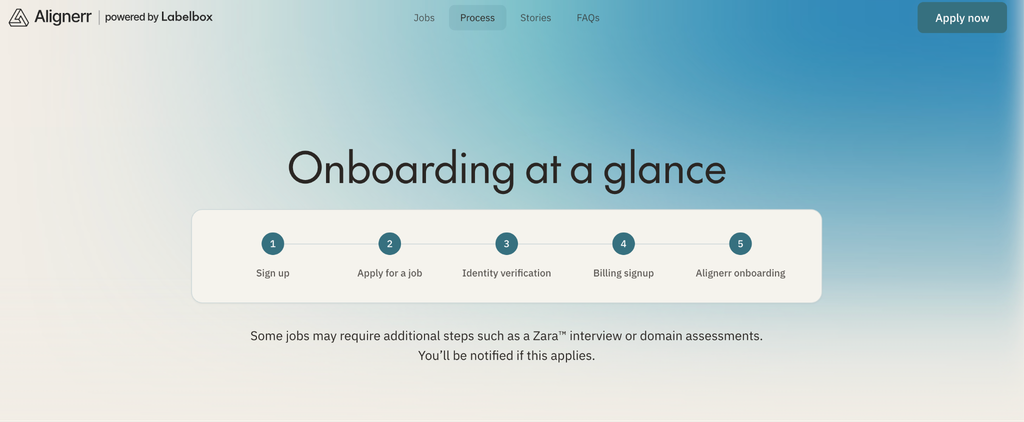
Alignerr’s current process page describes a five-stage application flow.
- Create your profile. Sign in with Google, upload a resume, and check the information extracted into your profile.
- Apply for an open position. Applications are tied to specific jobs or subject areas rather than one universal contributor application.
- Verify your identity. Alignerr may require phone verification and a government-issued identity document through Persona.
- Complete the contract and payment setup. Approved applicants receive contractor and billing instructions based on their country and project.
- Finish project onboarding. Training, calibration, an interview, or a subject assessment may be required before production work appears.
Creating an account alone does not place an applicant into a paid queue. Applications and project assignments are separate decisions, and a contributor may qualify for one field without matching an active client project.
Does Alignerr use AI interviews?
Some Alignerr jobs include an interview conducted by Zara, an AI interviewer. Other positions may use a subject assessment, a resume review, or a different qualification sequence. The interview is therefore job-specific rather than mandatory for every Alignerr applicant.
Applicants should read the recording terms before proceeding. Alignerr’s published terms and privacy information allow AI interviews to be recorded and grant the company broad rights covering the applicant’s image, voice, likeness, answers, and submitted materials. The terms also permit use of interview material to operate and improve its services and AI systems.
Completing the interview does not create a right to employment, a project, or payment. It remains part of the evaluation process.
Privacy concerns about this step appear in community discussions. One recent applicant asked whether Alignerr was legitimate after reading the interview release. The thread shows that applicants question these clauses, while the factual details come from Alignerr’s own published terms.
Why did I finish onboarding but receive no project?
Passing an assessment makes you eligible for consideration, but it does not reserve work. Alignerr says assignment timing depends on client demand, skill match, assessment performance, availability, location, and previous project results.
In recent discussions, one contributor reported waiting for more than two months after completing assessments, while another asked why no projects appeared after an assessment. A newly onboarded applicant also reported seeing no available tasks.
These posts cannot establish an average waiting period. Project availability can change by subject and client demand, so another contributor’s timeline may not predict yours.
If your account has no project, check that your profile is complete, review current job listings, confirm that all required assessments are finished, and watch the official dashboard and email account for invitations. Support cannot manufacture demand, but it can verify whether a technical or verification issue is blocking your profile.
How much does Alignerr pay?
Alignerr does not have one standard contributor rate. Pay depends on the job, subject, country, client budget, billing model, and review requirements.
Its current process page advertises examples reaching $150 per hour for selected finance, computer-vision, or machine-learning work and up to $120 per hour for some legal projects. These are high-end examples associated with particular specialist roles, not average earnings across the platform.
Individual vacancies provide better context. For example, a public AI Data Quality Analyst listing advertised a broad hourly range ($40-120/hr). The actual offer, location conditions, project duration, and available hours still need to be confirmed inside the application.
Before comparing Alignerr with another platform, separate four figures:
- Advertised rate: The range shown in a job listing
- Accepted rate: The amount in your project or contractor agreement
- Payable unit: An hour, task, accepted task, turn, or media hour
- Effective hourly earnings: Pay received divided by all time spent on the work
The last figure can differ sharply from an advertised rate when training, rejected tasks, waiting time, or extensive rework is involved.
How does Alignerr calculate payment?
Labelbox’s Alignerr Payment FAQs document several billing models.
| Per hour | Approved tracked working time | Hourly rate and required timer |
|---|---|---|
| Per task | A task or data row reaches the required DONE state | Task price and review status |
| Per accepted task | A submitted task passes review | Acceptance and rework rules |
| Per task per turn | The approved number of conversation turns | Definition of a payable turn |
| Per media hour | Duration of the processed audio or video | Media length rather than labor time |
| Upwork contract | Time or milestones recorded under the Upwork contract | Upwork’s payment and tracking rules |
For a per-media-hour project, processing 30 minutes of audio could produce payment for half a media hour even if the contributor spends longer completing it. Media duration and working time are different measurements.
Under an accepted-task model, finishing a task does not automatically make it payable. It must pass the project’s review standard. Contributors should read the rejection, rework, and appeal rules before beginning production.
Labelbox says the billing mode is selected before calibration or production. If a per-task rate changes, the rate shown when the task was submitted should determine payment for that task.
How often does Alignerr pay?
The current payment FAQ describes a weekly billing period running from Monday through Sunday. Approved work from that period is scheduled for payment by the following Friday.
Payment providers vary by region. The current documentation refers to Stripe or PayPal depending on the contributor’s country, while contributors hired through Upwork receive payment through Upwork.
If you use proxies while connecting payment platforms, we recommend using ISP proxies, as they provide more stable connection and fast speed.
Parts of Alignerr’s general FAQ still mention Deel. This appears to be older or overlapping documentation. Follow the payment provider shown in your active project or contract, and contact support if the dashboard, onboarding instructions, and agreement name different systems.
What does a $0 hourly rate mean?
A project displaying $0 per hour requires clarification before any work begins. It may refer to an unpaid evaluation, a calibration phase, a project that pays by task instead of by hour, or an incorrectly configured project card.
In one recent community discussion about a $0 hourly display, contributors interpreted the figure as an evaluation or calibration stage followed by a separate production rate. That explanation came from community members and may not apply to another project.
Check the contract, project description, billing unit, training rules, and production rate. Do not assume that a later rate will apply retroactively unless the project terms say so.
What do contributors report about payment?
Recent payment discussions contain both payment confirmations and disputed-work complaints.
A reviewer reported missing VQA backpay. In another thread, a contributor initially described unpaid work and later said a different Alignerr project had paid. A more critical post alleged substantial unpaid hours, while comments under the same post included people who said they had completed projects and received payment.
These discussions show why project records should be saved before a queue closes or access changes.
Keep copies of:
- The job listing and accepted rate
- The project’s billing mode
- Training and calibration terms
- Task or data-row identifiers
- Submission and acceptance states
- Hubstaff or Upwork time records
- Rework requests and deadlines
- Support tickets and payment-provider notices
Our comparison of AI training platforms that pay provides additional context on rates, qualification processes, and payout systems used by other providers.
Which countries can use Alignerr?
Alignerr’s FAQ says qualified applicants can apply from around the world, while Labelbox markets the contributor network as operating across more than 40 countries. Neither statement guarantees that every current vacancy accepts every country.
Eligibility depends on:
- The location rules in the job listing
- The client project’s permitted countries
- Accepted identity documents
- Local independent-contractor rules
- Work authorization or visa conditions
- Availability of the required payment provider
- Language, subject, and time-zone requirements
Alignerr does not offer visa sponsorship and tells applicants to determine whether their status permits contract work. A vacancy described as remote may still restrict applicants to a particular country or region.
Does location affect Alignerr pay?
Location can affect Alignerr rates, although U.S. offers are not always higher. Current listings show that the project and required expertise also shape the range.
A U.S.-preferred Physics Expert role lists a U.S. range of $25 to $100 per hour. Similar physics positions in India and South Africa advertise $35 to $55 per hour. The U.S. listing has a higher ceiling, while the other two have a higher minimum.
Other vacancies use the same range across countries. Hindi transcription pays an advertised $10 to $35 per hour for applicants in the United States and around Mumbai, India. Specialist roles outside the U.S. can also pay more: a Brazilian cybersecurity position and a South African finance role both advertise $60 to $120 per hour.
Community reports describe sharper differences inside individual projects. One Pulsar applicant in Spain reported a $10 to $30 hourly range, while a commenter in Egypt claimed a rate of about $3 per hour. These are unverified personal reports, not official country rates.
Compare offers by role, country, payment unit, qualifications, and acceptance rules. The rate in your project agreement is the figure that applies. Never change your account country or network location to obtain another region’s vacancy or rate.
NodeMaven’s ISP proxies provide static residential IPs in key locations worldwide, including the United States, for consistent geo-targeted sessions. Use an IP only in your verified work location.
Use NodeMaven’s quality-checked ISP proxies for stable sessions and precise geo-targeting in your verified work location. Use code ISP25 to get 25% off your first order of two or more IPs.
Is Alignerr safe?
Alignerr has the operational features expected from a real contractor platform, including published legal terms, identity verification, project agreements, and documented support channels. Those controls do not remove every privacy, payment, or account-access concern.
A better safety check examines what information the platform collects, how work is monitored, and which rights the contributor grants during an interview or project.
What information does Alignerr collect?
Alignerr’s privacy documentation says the company may process:
- Contact and account identifiers
- Employment, education, and professional information
- Identity-document information
- Photos, video, audio, and interview recordings
- Face or voice biometric identifiers
- Device and electronic activity information
- IP-based geolocation
- Payment and tax details
- Inferences used for fraud prevention and project matching
Persona is used for identity verification. Alignerr also describes ongoing monitoring intended to detect fraud, policy violations, and suspicious account activity.
Before submitting an ID or interview recording, confirm that the page belongs to Alignerr, Labelbox, Persona, the named payment provider, or another verified project service. Avoid identity links sent through unofficial messaging accounts.
What does Hubstaff monitor?
Some Alignerr projects use Hubstaff to record payable working time. Alignerr’s Hubstaff FAQ says the software can capture periodic screenshots and record which websites and applications are used during a tracked session.
For work completed inside Labelbox, the task interface may prevent a contributor from continuing when the required timer is not detected. Other projects can use timer data to calculate billing or investigate discrepancies between completed tasks and reported hours.
Before starting the timer, close personal messages, financial accounts, unrelated documents, and anything else that should not appear in a work screenshot. Use a separate browser profile or work device when possible, while following the project’s device rules.
Why can an Alignerr account be suspended?
Alignerr’s community rules prohibit duplicate accounts, account sharing, manipulated assessments, inaccurate identity information, timer manipulation, confidentiality breaches, and attempts to obtain credit for work not personally completed.
The FAQ also names repeated low-quality work, inactivity, failed verification, and policy violations as possible reasons for delayed payment, account review, or loss of project access. Alignerr says screen activity may be logged.
Community reports show how confusing an account review can be from the contributor’s side. One applicant reported receiving a fraud suspension after an interview. Comments in the same discussion included contributors who said they had worked on the platform and received payment for about a year.
Another applicant reported applying to several projects without receiving a Zara interview or a clear support response. These are individual reports, so they show possible failure points without revealing how frequently they occur.
For account, project, or payment problems, Alignerr directs contributors to in-app Intercom support or [email protected]. Send one organized request containing the project name, relevant dates, task identifiers, screenshots, payment model, and the resolution you are requesting.
ISP proxy setup for Alignerr
Use a proxy only after receiving permission from Alignerr, Labelbox, or the project administrator. The connection should remain in your verified country and approved working location.
Alignerr’s public rules do not provide blanket permission for proxy use. Its privacy notice says IP-based geolocation can be collected, and its rules prohibit attempts to manipulate assessments, time records, verification, or account eligibility. A project or client may also have network requirements that do not appear in the general terms.
An authorized contributor may use a dedicated ISP IP when a project permits remote-network tools and requires a stable endpoint for a consistent work session. This can reduce accidental IP changes caused by mobile networks, shared connections, or switching between locations.
We offer quality-checked ISP proxies for a stable, geo-targeted connection. Keep the IP in your verified work location and avoid changing it during an active Labelbox or Hubstaff session.
Use NodeMaven’s quality-checked ISP proxies for stable sessions and precise geo-targeting in your verified work location. Use code ISP25 to get 25% off your first order of two or more IPs.
How to configure the connection
- Select an authorized location. Choose the country and region confirmed by the project administrator.
- Configure your browser or approved client. Follow NodeMaven’s Chrome proxy settings guide for browser-based work or the SOCKS5 configuration guide for compatible applications. Or use a supported application. NodeMaven’s integration directory contains setup options for desktop and mobile proxy clients.
- Check the visible IP and region with an IP lookup tool. They should match the location authorized for your contributor account.
- Test every required platform. Confirm that Alignerr, Labelbox, Hubstaff, and the assigned project open correctly before starting the timer.
- Keep the same IP during the session. Avoid changing endpoints in the middle of tracked or payable work.
- Stop when systems disagree. Contact the project team if Labelbox shows tasks while the timer is blocked, or if the visible location differs from the approved region.
Which Alignerr alternatives should you compare?
Project-based AI work changes quickly, so keeping profiles on several legitimate platforms can reduce dependence on one queue. Always check confidentiality and exclusivity clauses before working on similar projects for different companies.
Remotasks
Remotasks offers image annotation, data labeling, model evaluation, and specialist projects. Our Remotasks review covers its training system, project availability, country restrictions, payment, and contributor complaints.
Compare Remotasks with Alignerr if you want access to a broader range of general annotation work and are prepared for changing queues.
TELUS Digital AI
TELUS Digital recruits contractors for search evaluation, advertisement rating, mapping, data collection, and language projects. The TELUS Digital AI review explains its assessments, location requirements, and project structure.
TELUS may suit applicants seeking established evaluation programs with clearly defined regional vacancies, although hours can still vary.
Mercor
Mercor focuses on recruiting professionals for specialist contract roles and uses automated screening in parts of its application process. Our Mercor review examines its AI interviews, job matching, rates, and privacy questions.
Compare Mercor with Alignerr if your background fits software, finance, law, science, operations, or another specialist field.
Handshake AI
Handshake AI connects academic and professional expertise with model-training projects. The Handshake AI review covers eligibility, recruiting, project access, and reported contributor experiences.
Handshake may appeal to students, researchers, and subject specialists, depending on the current openings and institutional requirements.
Apply to Alignerr when a live vacancy matches your experience and the rate, payable unit, review process, and monitoring method are clearly stated. Keep another source of income until a paid assignment appears and the first payment clears.


