Best proxy for web scraping in 2026 (11 providers tested)



A tested, no-fluff comparison of the best proxy for web scraping right now, built for developers, data teams, and businesses that need reliable access at scale.
Why proxies matter for web scraping
Send too many requests from one IP address and most sites notice. Rate limits kick in. CAPTCHAs appear. Eventually your IP gets blocked entirely. That’s the reality of scraping large websites without a proxy layer in front of your requests, and it’s the problem a good scraping proxy solves.
Proxies spread your traffic across many IP addresses so no single one looks suspicious. This is what makes web scraping proxies a baseline requirement for anyone pulling data at volume. It’s the fastest way to avoid IP bans while scraping instead of chasing retries after the fact.
Residential proxies dominate this space because they route requests through real household IP addresses instead of server infrastructure. To a target site, that traffic looks like an ordinary visitor. Datacenter IPs are faster and cheaper, but easier to fingerprint, which makes web scraping without getting blocked harder to pull off with datacenter IPs alone.
A good proxy for web scraping comes down to a few things: enough IPs to avoid repeat exposure, clean IP reputation, flexible session control, and honest pricing. This guide ranks 11 providers to help you find the best proxy for web scraping your project actually needs.

Collect web data without IP bans. Start with NodeMaven for just $3.50 and get 750 MB of premium proxy traffic
How we evaluated these web scraping proxies
We reviewed each provider’s official documentation and pricing pages, then scored them on the factors that actually affect scraping outcomes:
- IP quality and pool size: how many IPs, and how clean is the pool
- Success rate: published performance on protected targets
- Rotation and session control: sticky sessions vs per-request rotation
- Geo-targeting: country, city, and ISP-level precision
- Pricing: entry cost, per-GB rate, and trial availability
- Dashboard and support: how fast you can go from signup to first request
NodeMaven ranks first in this list. Its edge isn’t pool size, since several competitors publish larger raw IP counts. It’s the combination of a real-time IP quality filter, long sticky sessions, and pricing that stays reasonable at low volume, which matters more once you’re running proxy scraping jobs against a genuinely protected site.
Quick comparison table
| Provider | Best For | Residential IPs | Countries | Sticky Sessions | Starting Price |
| NodeMaven | Overall quality & value | 30M+ | 190+ | Up to 24 hours | $2.20/GB |
| Bright Data | Enterprise scale | 400M+ monthly | 195 | Configurable | ~$5.04/GB |
| Oxylabs | Large-team data pipelines | 175M+ | 195 | Up to 30 min | $4/GB |
| Decodo | Self-serve mid-market | 115M+ | 195+ | Up to 30 min | $2/GB |
| Webshare | Budget & free tier | 80M+ | 195 | Up to 24h | $1.40/GB |
| SOAX | Carrier-level targeting | 155M+ | 195 | Up to 60 min | $4/GB |
| Rayobyte | Ethically sourced, PAYG | 40M+ | 100+ | Yes | ~$3.50/GB |
| IPRoyal | Non-expiring traffic | 32M+ | 195+ | Up to 24 hours | $1.75–$7/GB |
| Infatica | ISO-certified compliance | 20M+ | 195 | Yes | $0.30–$8/GB |
| ProxyEmpire | Rollover bandwidth | 30M+ | 170+ | 1–30 min | $1.97/GB |
1. NodeMaven
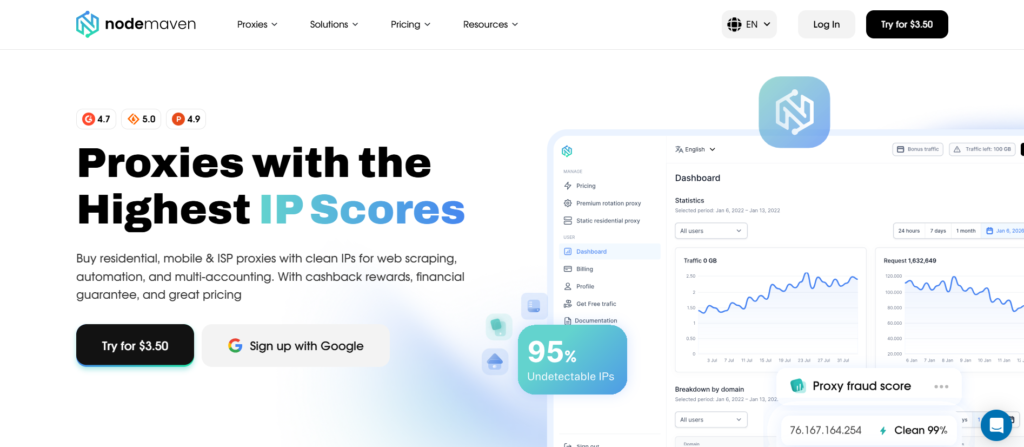
NodeMaven built its residential network around a proprietary IP filter that screens every IP for fraud score and blacklist status before it’s ever handed to a user. The result is a pool of over 30 million residential, ISP, and mobile IPs across 190+ countries and 1,400+ cities, with clean-IP rates over 95%.
For anyone tired of burning traffic on flagged IPs, this shows up directly in your success rate, not just in the marketing copy.
Best for: Developers and businesses who want the best proxy for web scraping without enterprise pricing or a sales call. It’s a strong fit for antidetect browser stacks, multi-account management, and price monitoring.
Key features
- 30M+ residential IPs, plus mobile pools, under one subscription
- 190+ countries and 1,400+ cities with ZIP and ISP-level targeting
- Sticky sessions held for up to days, or rotation per request
- HTTP and SOCKS5 support with unlimited concurrent sessions
- Traffic rollover and cashback credit on unused bandwidth
Pros
- Real-time IP quality filtering reduces wasted requests
- Long sticky sessions rare at this price point
- Affordable entry pricing with a $3.50 trial
- Combined residential and mobile access under one plan
Cons
- Smaller raw IP count than the largest enterprise networks
- No managed unblocker or SERP API yet, so you handle rotation logic yourself
Between the filtering layer, the session flexibility, and the pricing, NodeMaven is consistently the best proxy for web scraping for teams that need reliability without an enterprise contract.
Power your web scraping projects with clean residential proxies. Try NodeMaven from $3.50 with 750 MB included
2. Bright Data
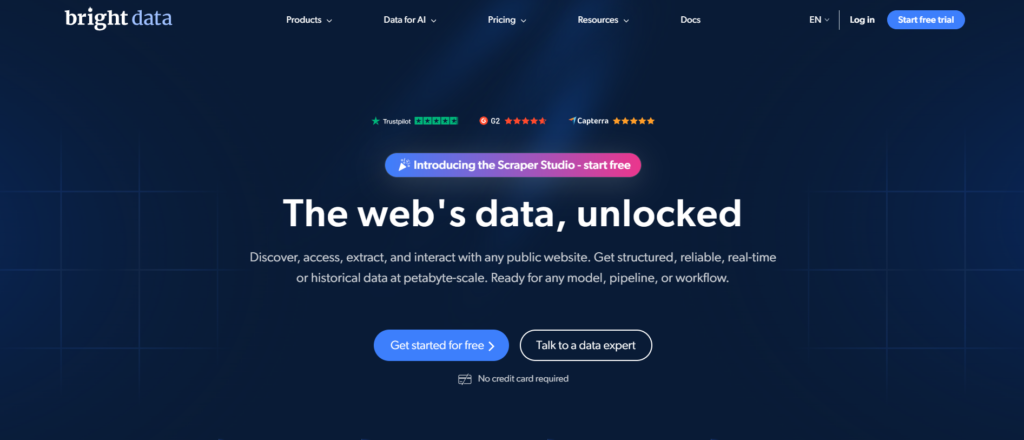
Overview: Bright Data runs the largest publicly advertised residential network in the industry, with 400M+ monthly IPs across 195 countries, plus a managed-scraping stack that includes Web Unlocker, Scraping Browser, and a SERP API.
Best for: Enterprise teams with compliance requirements and budget to match. The mandatory KYC process and premium pricing put it out of reach for casual users, but it’s hard to beat for coverage depth.
Key features
- 400M+ monthly residential IPs across 195 countries
- Targeting down to city, state, ZIP code, ASN, and carrier
- Datacenter, ISP, residential, and mobile networks in one account
Pros
- Unmatched geographic and pool depth
- Managed scraping tools reduce engineering overhead
Cons
- Premium pricing at every tier
- KYC process adds friction before first request
3. Oxylabs
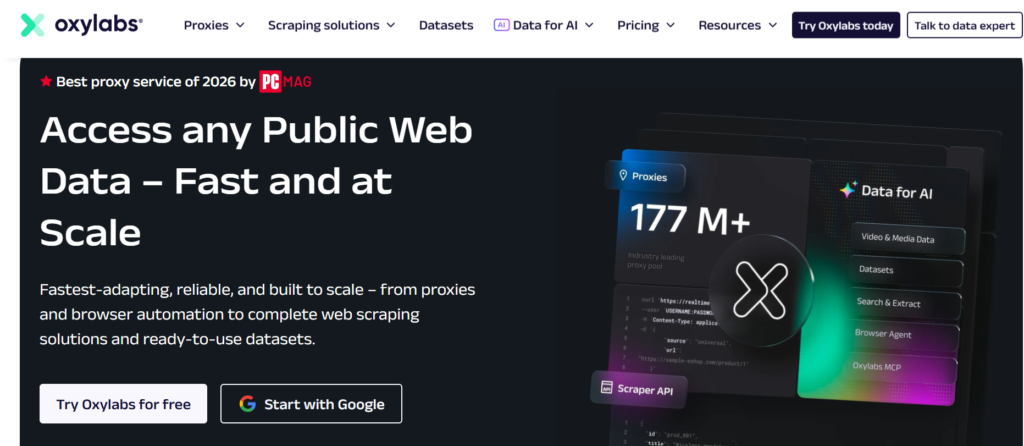
Overview: Oxylabs pairs a 175M+ IP residential pool with an equally deep product lineup: Web Scraper API, SERP API, and a Web Unblocker sit alongside standard proxy access, all covering 195 countries.
Best for: Agencies and data teams running high-volume, precision-targeted scraping who want managed tooling on top of raw proxy access.
Key features
- 175M+ residential IPs with country, state, city, ZIP, and ASN targeting
- Unlimited concurrent sessions on residential plans
- Mobile pool of 20M+ IPs across 140+ countries
Pros
- Very large, well-maintained IP pool
- Full scraping API suite reduces custom tooling
Cons
- Entry pricing sits above mid-market alternatives
- Free trial requires contacting sales
4. Decodo
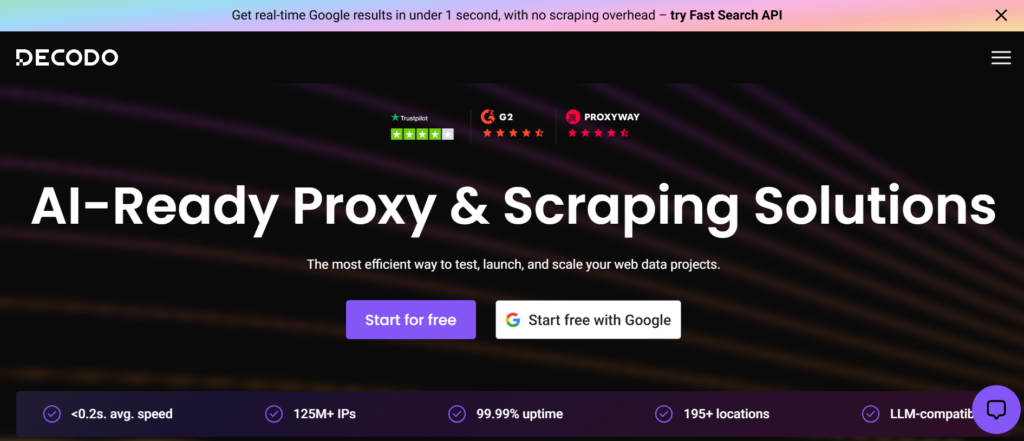
Overview: Formerly Smartproxy, Decodo runs a 115M+ IP residential network across 195+ locations with a self-serve signup flow that skips the KYC gate most premium providers require.
Best for: Teams that want a large residential proxy network without enterprise sales friction, priced from $2/GB.
Key features
- 115M+ residential IPs across 195+ locations
- Country, continent, state, city, and ZIP-level targeting
- Unlimited concurrent sessions plus a 3-day free trial
Pros
- Fast, card-based onboarding
- Competitive pricing at low and mid volume
Cons
- Sticky sessions cap lower than several competitors
- Rebrand from Smartproxy confuses older reviews
5. Webshare
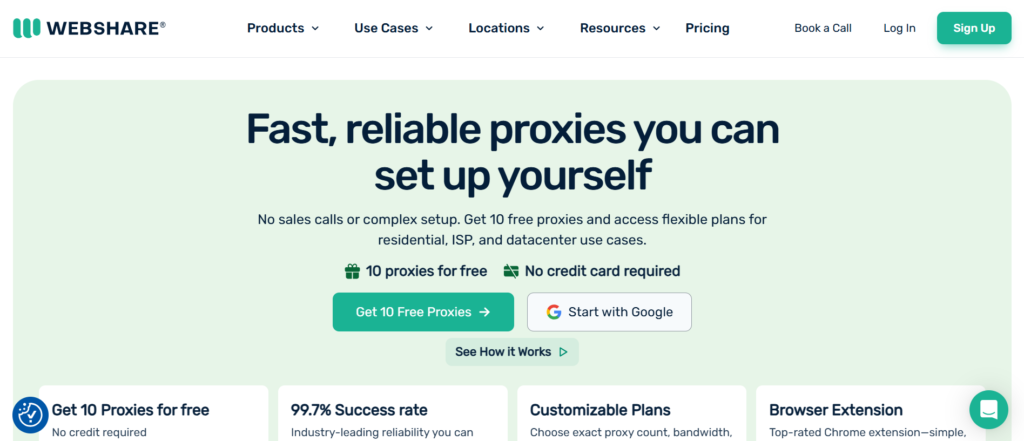
Overview: Webshare is the rare provider with a genuinely permanent free plan: 10 proxies and 1GB of bandwidth, no credit card required. Paid residential plans scale from an 80M+ IP pool across 195 countries.
Best for: Freelancers, small teams, and anyone who wants to test a web scraper proxy setup before committing budget.
Key features
- 80M+ residential IPs with country and city targeting
- Permanent free tier plus paid plans from $1.40/GB
- Datacenter proxies from $0.05/IP for low-detection targets
Pros
- Genuinely free forever tier, no card required
- Lowest entry pricing on this list
Cons
- Shared plans can hit rate limits on popular targets
- Residential success rates trail the premium tier
6. Roundproxies
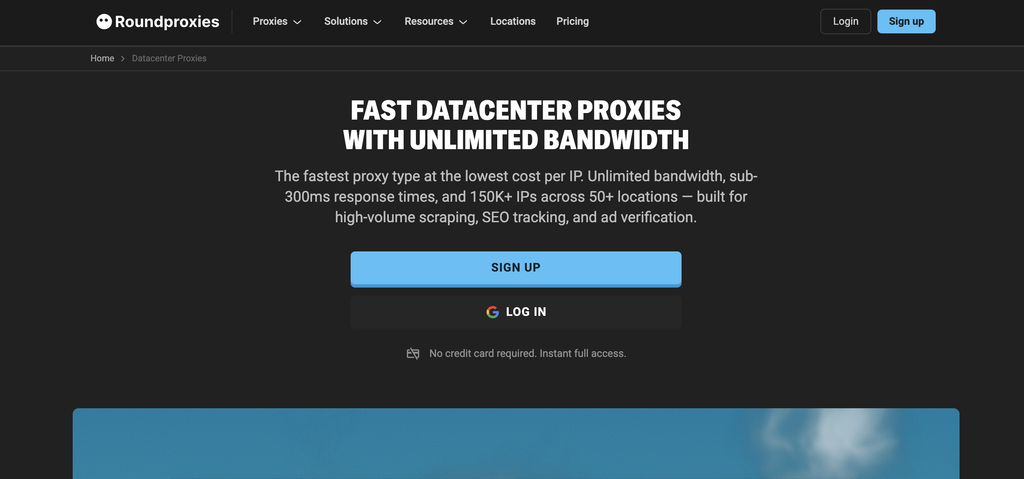
Overview: Roundproxies offers a datacenter proxy network designed for high-volume scraping, with unlimited bandwidth and unlimited concurrent sessions included. Because you pay per IP rather than per GB, traffic costs stay predictable no matter how much data you pull.
Best for: Large-scale data collection on targets with light or moderate anti-bot protection, where speed and cost control matter more than residential-level trust.
Key features
- 150K+ datacenter IPs with unlimited bandwidth
- Unlimited concurrent sessions for parallel scraping jobs
- Per-IP pricing from $0.30/IP, with no per-GB traffic charges
Pros
- No bandwidth caps, so large jobs don’t inflate your bill
- Fast, stable connections suited to high-throughput workloads
Cons
- Datacenter IPs are easier to flag on heavily protected sites
- Fewer datacenter locations than some competitors, especially in Asia-Pacific
7. SOAX
Overview: SOAX runs a curated 155M+ IP residential pool, plus a dedicated mobile network, with carrier-level ASN targeting exposed on every plan rather than gated behind an enterprise tier.
Best for: Precision geo-targeting work, including carrier-specific mobile scraping and ad verification.
Key features
- 155M+ residential IPs across 195 countries with ISP and ASN targeting
- Sticky sessions tunable from 30 seconds up to roughly 60 minutes
- HTTP(S), SOCKS5, UDP, and QUIC protocol support
Pros
- Deep carrier and ASN-level targeting
- Wide protocol support including QUIC
Cons
- No pay-as-you-go option, and unused GB don’t roll over
- $90/month minimum on the entry plan
8. Rayobyte
Overview: Rayobyte is built around explicit ethical sourcing: every residential IP comes from users who opted in and are compensated for participation. The pool covers 40M+ IPs across 100+ countries.
Best for: Teams that prioritize documented ethical sourcing and simple pay-as-you-go billing with no expiring bandwidth.
Key features
- 40M+ ethically sourced residential IPs in 100+ countries
- Pay-as-you-go with bandwidth that never expires
- City, region, and country-level targeting at no extra cost
Pros
- Transparent, documented ethical sourcing policy
- No monthly minimums on residential plans
Cons
- Smaller country footprint than top-tier networks
- Dashboard feels dated next to newer entrants
9. IPRoyal
Overview: IPRoyal’s standout feature is non-expiring traffic: bandwidth you purchase stays in your account indefinitely instead of resetting monthly. Its pool covers 32M+ residential IPs across 195+ countries.
Best for: Bursty, irregular scraping workloads where you don’t want to lose unused bandwidth at the end of a billing cycle.
Key features
- 32M+ residential IPs across 195+ countries with city and ASN targeting
- Pay-as-you-go pricing from $7/GB down to $1.75/GB at bulk volume
- Sticky sessions held for up to 24 hours
Pros
- Bandwidth never expires
- No monthly minimum or long-term contract
Cons
- Smaller pool means more retries on the toughest anti-bot targets
- Entry per-GB rate is higher than budget competitors
10. Infatica
Overview: Infatica pairs a 20M+ IP residential pool across 195 countries with ISO 27001 certification, appealing to compliance-conscious buyers who still want flexible, usage-based pricing.
Best for: Businesses that need documented security compliance alongside standard residential and mobile proxy access.
Key features
- Residential IP pool spanning 195 countries with city-level targeting
- ISO 27001 certified infrastructure
- Pay-as-you-go and subscription pricing models
Pros
- Security certification uncommon among peers
- Flexible, customizable plan sizing
Cons
- Entry-level pricing runs higher than budget competitors
- Dashboard UX draws mixed feedback
11. ProxyEmpire
Overview: ProxyEmpire’s defining feature is bandwidth rollover. Unused data doesn’t expire at the end of the billing cycle, which is unusual among backconnect providers. The pool spans 30M+ ethically sourced IPs across 170+ countries.
Best for: Project-based scraping work with unpredictable monthly volume, where losing unused bandwidth would otherwise be wasteful spend.
Key features
- 30M+ residential IPs across 170+ countries with city and ISP targeting
- Rollover bandwidth that carries forward month to month
- Static residential, rotating mobile, and unlimited-bandwidth plan options
Pros
- Rollover data is a genuine cost saver for irregular usage
- Broad country and carrier filtering
Cons
- Smaller advertised pool than several rivals
- Response times can lag outside North America and Europe
Residential vs Datacenter vs ISP Proxies
Residential proxies route traffic through real ISP-assigned IPs tied to household devices. They’re the hardest type to detect, which is why they’re the default choice for most scraping work today.
Datacenter proxies come from hosting providers instead of ISPs. They’re fast and cheap, but their IP ranges are well documented, so sites with any anti-bot layer flag them quickly. They still work for low-protection targets.
ISP proxies, also called static residential proxies, split the difference. You get residential-level trust with datacenter-level speed and a fixed IP for the session, which matters for logins, checkout flows, and account management.
For most projects, residential proxies are the right default. Reach for ISP proxies when you need the same identity to persist for hours or days, and datacenter proxies only when the target has no real bot defenses.
Scrape faster with high-quality residential proxies. Get started with NodeMaven for $3.50 and receive 750 MB of traffic
How to choose a proxy for web scraping
A few questions narrow the field fast when picking a proxy service for web scraping:
- What are you targeting? Heavily protected sites need residential or mobile IPs. A basic proxy for scraping websites with light protection doesn’t need the premium tier.
- Rotation or persistence? Bulk collection favors per-request rotation. Logins need sticky sessions.
- How clean is the pool? A large pool with poor filtering still produces flagged IPs. Look for a published quality-control process, not just a raw IP count.
- How precise is your targeting? City or ZIP-level matters for local SEO and geo-restricted content.
- What’s your concurrency? High-volume scraping needs unlimited concurrent sessions.
- What’s pricing at your real volume? Entry and bulk rates can differ 3 to 4x, so model your monthly GB before committing.
At real scale, the best residential proxies for web scraping are usually worth the premium over datacenter alternatives. For lighter, bulk jobs where IPs rotate constantly, the best rotating proxies for scraping get judged on pool size and rotation speed over session stability. Either way, picking proxies for web scraping means matching a provider’s strengths to your workload, not chasing the biggest advertised pool.
Conclusion
Every provider on this list can move data. The differences show up in how much of that data arrives clean, how long a session holds, and what happens to your budget once you scale past a trial. Bright Data and Oxylabs win on raw pool size and managed tooling, at premium prices. Webshare and IPRoyal win on flexible, low-commitment pricing. SOAX carves out strong niche in carrier targeting and speed.
NodeMaven earns the top spot in this comparison because it balances all of that: a filtered, high-quality residential proxy pool, sessions that hold for up to 24 hours, and pricing that doesn’t punish smaller projects. Whichever web scraping proxy service you land on, test it against your actual targets before committing budget.
For teams evaluating the best web scraping proxies available right now, NodeMaven is the one worth testing first.
Reduce blocks and improve scraping success. Try NodeMaven for just $3.50 and claim 750 MB of premium proxy traffic