





micro1 AI Review: Jobs, Pay, and Eligible Countries


Earning $180 an hour from home is an appealing offer. micro1 advertises $150 to $180/hour for a US-based Hematology Physician role and $100 to $170/hour for physics experts. There are generalist opportunities too: a short Prompt & Response Evaluator project advertises up to $70/hour without requiring coding or previous AI-evaluation experience. This review looks at the qualifications behind those rates, how applicants get selected, and what contributors report about the work.
micro1 recruits remote contractors for AI training and evaluation projects, from audio annotation to reviewing code and medical records.
We’ve already covered Pila8, TELUS International AI, MultiMango, and Babel Audio. This review covers micro1 AI advertised rates, eligible countries, the Zara interview, payment schedules, and what contributors say about working on the platform.
Key takeaways
- Specialist offers reach $180/hour. A Hematology Physician role advertises $150 to $180/hour, while Physics Expert roles list $100 to $170/hour. A short generalist evaluation project also advertises up to $70/hour, with approximately 7.5 hours.
- Some regional offers start higher. The US and Philippines English-language examples start at $20/hour, compared with $15/hour for India and Australia/New Zealand. All share a $45 ceiling, and the roles require different regional-English expertise.
- Check whether you’re paid for hours or completed tasks. micro1 uses hourly, per-task, and flat-fee arrangements. On output-based projects, time spent on revisions can reduce your effective hourly earnings.
- Passing Zara puts you into project matching. The Talent Dashboard guide describes a human-review stage that can take up to 30 days. Check the vacancy’s country requirements before applying.
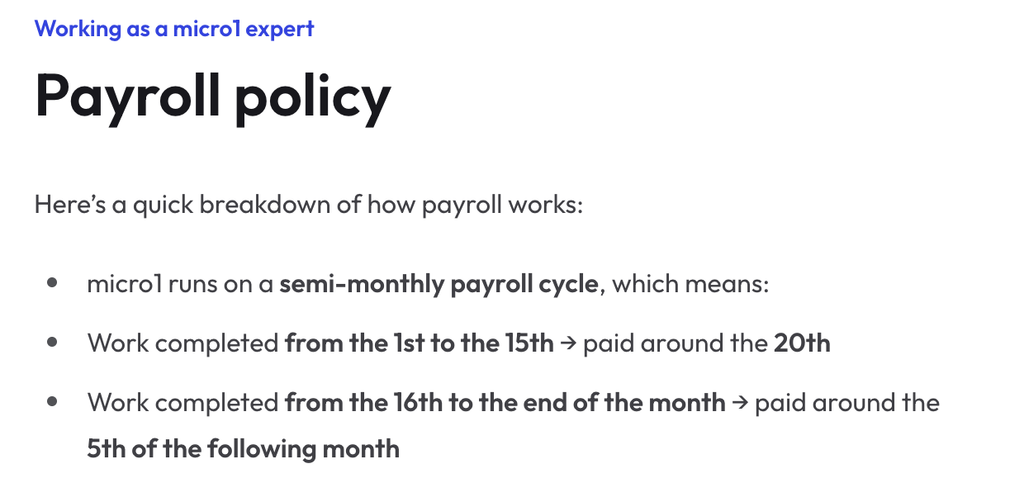
- Payroll runs twice a month. Work completed from the 1st to the 15th is scheduled for payment around the 20th; work from the 16th onward is scheduled around the 5th of the following month, subject to the payroll policy’s timing adjustments.
- Keep a consistent IP for your AI training projects. NodeMaven ISP proxies provide dedicated static addresses in countries including the US, UK, and Germany, with unlimited traffic and TCP/UDP support through compatible clients. Choose your approved location and use Connection Checker to check for IP leaks before starting work.

For projects that permit proxies, NodeMaven ISP proxies give you a dedicated, quality-checked static address with unlimited traffic and TCP/UDP support through compatible clients. From $2.33/IP/30 days with code ISP25 for new users when buying 2+ IPs.
What is micro1, and is it legit?
micro1 connects subject-matter experts with projects that train and evaluate AI systems. Contractors might review code, check clinical documentation, annotate recordings, or write tasks that expose mistakes in an AI model’s answers.

Zara is the AI recruiter used to screen applicants. Once candidates demonstrate the required skills, their profiles can be considered for matching projects. The work itself happens after selection and onboarding.
There is evidence of paid work beyond recruitment advertisements. In a six-month contributor account, a worker describes starting on a $30/hour project and earning enough to cover living expenses. The same account criticizes support and inconsistent communication about work availability.
What jobs can you do on micro1?
The opportunities portal covers professional evaluation as well as language, recording, and generalist projects. These examples show what the work asks you to do:
| Work area | Example tasks | Relevant background |
| Software and coding | Review generated code, solve problems, write tests, explain errors | Programming and code-review experience |
| Medical coding | Check clinical notes and coding accuracy | Inpatient coding knowledge and relevant certifications |
| Language and audio | Label speakers and accents, correct transcripts, assess language use | Familiarity with the required dialect and language-focused work |
| Generalist and agent evaluation | Complete digital workflows, record results, give structured feedback | Practical work experience and confidence using online tools |
| Recording and video | Produce recordings that meet a project’s specifications | Required equipment, location, and ability to follow recording instructions |
For example, the Inpatient Coder offer concerns US-based work involving ICD-10 and CPT coding, clinical documentation, and AI-generated records. It lists coding certifications and current professional experience among its preferred qualifications.
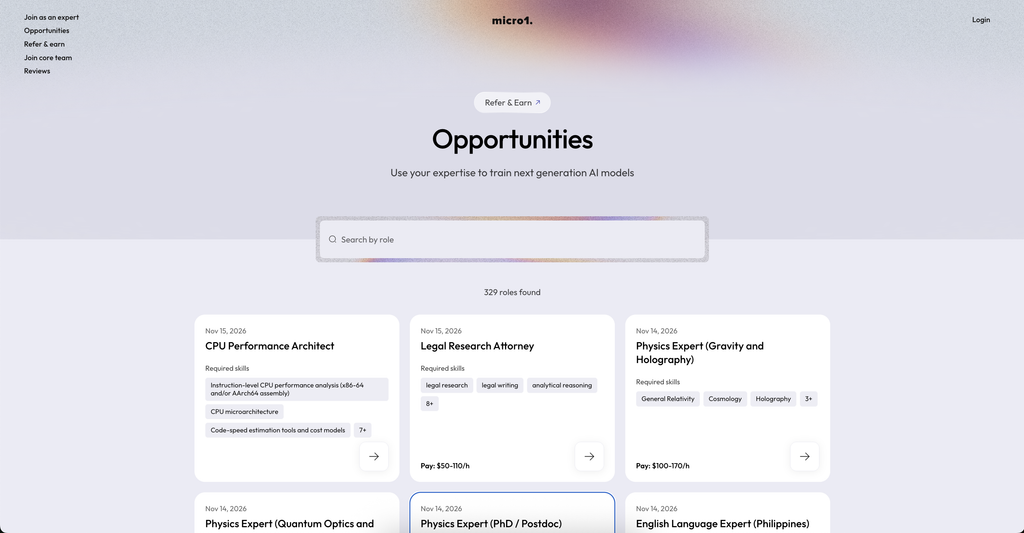
The Prompt & Response Evaluator project involves comparing AI assistants through everyday conversations, rating their responses, and writing brief feedback. It welcomes generalists and asks for an active personal ChatGPT account used at least three times a week. The assignment estimates approximately 7.5 hours of work, scheduled for November 15 to 18, 2026.
Specialist work extends beyond medical coding. The Hematology Physician role involves reviewing AI-generated outpatient transcripts and clinical notes, with board certification in hematology or oncology among its preferred qualifications. Physics experts produce and validate advanced solutions, review other contributors’ reasoning, and document their work in LaTeX.
Which countries are eligible to work on micro1?
micro1 recruits internationally, with both platform-wide residency restrictions and country-specific vacancies. A remote listing can still require US residence, a particular regional dialect, or availability during specified hours.
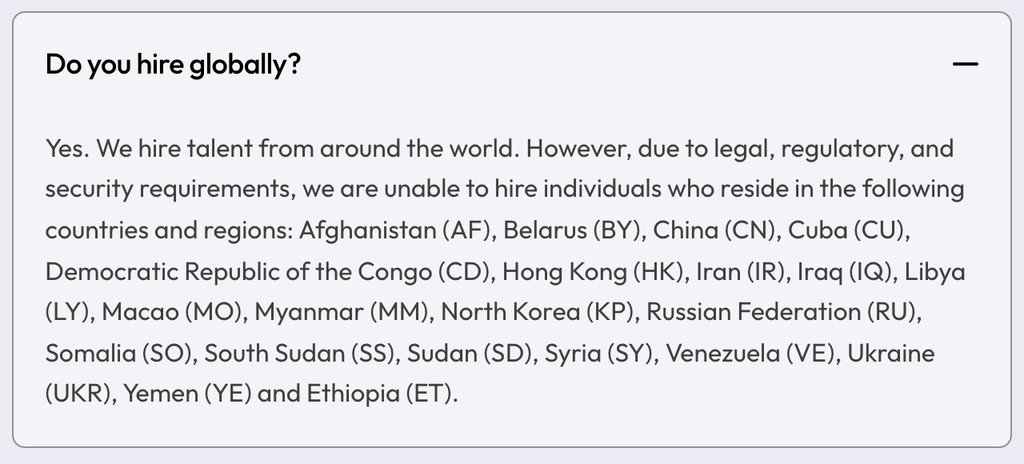
The official expert FAQ currently excludes residents of Afghanistan, Belarus, China, Cuba, the Democratic Republic of the Congo, Ethiopia, Hong Kong, Iran, Iraq, Libya, Macao, Myanmar, North Korea, Russia, Somalia, South Sudan, Sudan, Syria, Ukraine, Venezuela, and Yemen.
Outside those restrictions, the individual vacancy determines who can apply. Published examples include US-based inpatient coding, Europe-based video work, and English-language projects aimed at specific countries. For language assignments, residence and accent expertise can both be relevant.
Applicants also discuss time zones. In a thread about applications from Asia, a company representative says micro1 hires in Asia and identifies location, time zone, rate expectations, and availability as factors in project matching. The thread also includes a contributor reporting work from India.
How much does micro1 pay, and when?
Current micro1 listings include:
| Role | Advertised hourly pay | Requirements or project scope |
|---|---|---|
| Hematology Physician | $150 to $180 | US-based remote work reviewing clinical transcripts and notes. Board certification in hematology or oncology is a preferred qualification. |
| Physics Expert (PhD / Postdoc) | $100 to $170 | Advanced physics problem-solving, peer review, and LaTeX. PhD or postdoctoral research background preferred. |
| Legal Research Attorney | $50 to $110 | The opportunities board lists legal research, legal writing, and analytical reasoning skills. |
| Prompt & Response Evaluator | Up to $70 | Short generalist project comparing AI assistants; approximately 7.5 hours during November 15 to 18, 2026. |
The evaluator listing displays $40 to $70/hour in its header and $45 to $70/hour in the description. Confirm the offered rate before accepting. It welcomes applicants without coding or previous AI-evaluation experience.
Do some locations pay more?
Some country-specific offers have higher advertised minimums. For English Language Expert work advertisements show the following comparison:
| Country or region | Advertised hourly range | Work focus |
| United States | $20 to $45 | American English audio and transcripts |
| India | $15 to $45 | Indian English audio and regional language features |
| Philippines | $20 to $45 | Country-specific English-language work |
| Australia and New Zealand | $15 to $45 | Country-specific English-language work |
The current opportunities board also lists English Language Expert roles for Canada, Great Britain, Ireland, and South Africa at $20 to $45/hour. The $150 to $180/hour Hematology Physician offer is US-based, but it requires clinical expertise; it doesn’t establish that US contractors generally earn more for equivalent work.
The US and Philippines examples start $5/hour higher than the India and Australia/New Zealand examples, while all four share the same $45 ceiling.
These offers also require different regional-English expertise, so the ranges don’t isolate a pay premium based only on residence.
For projects that permit proxies, NodeMaven ISP proxies give you a dedicated, quality-checked static address with unlimited traffic and TCP/UDP support through compatible clients. From $2.33/IP/30 days with code ISP25 for new users when buying 2+ IPs.
How task-based payment works
micro1’s project payment FAQ describes three arrangements:
- Hourly: payment for tracked hours approved by the project team.
- Pay per task: each approved task earns a set amount calculated from your contractual hourly rate and a “Project Payout Multiple” specified in the contract. Taking longer to complete the task doesn’t increase its payment.
- Flat fee: a fixed payment for an accepted deliverable. Incomplete or rejected submissions aren’t paid under that model.
For pay-per-task work, find the payout multiple in the contract’s Special Clauses. Recording time may still be required even when the task payment doesn’t follow every minute spent working.
This is the rule behind some contributor disagreements about task timing. If a task pays $15 and takes an hour including revisions, your effective earnings are $15/hour. Check the payment per accepted task before using the advertised hourly rate to estimate income. Our Pila8 review covers a related issue with payment for approved audio output.
Payroll dates and Deel
The official payroll policy sets out this schedule:
| Work period | Scheduled payment |
| 1st to 15th of the month | Around the 20th |
| 16th to the end of the month | Around the 5th of the following month |
An approval notification can arrive before the money. Payroll uses Pacific time, and weekends or US bank holidays move the expected payment day. US contractors may also face an additional business day for their payment method.
Complete the contract and identity checks in Deel before expecting payment. If an approved payment is overdue, contact your assigned micro1 coordinator, referred to as your “pipeline lead.”
How do you apply, and what is the Zara interview?
Start with a role on the official portal and complete the application using experience relevant to that vacancy. Expect to provide profile information and, where requested, your availability and desired rate.
Zara then asks role-specific questions that you answer aloud. micro1’s interview guide gives a 20 to 40-minute duration, depending on the skills being assessed, and says sessions are recorded for recruiter review.
Certified skills can reduce later interviews
You may not need another full interview for every application. Zara compares a new role’s requirements with your qualifying results from interviews completed after July 2025.
If only some skills are missing, the portal can show Partial interview. If the existing results cover everything required, Fast-Track can skip the interview.
After meeting the certification criteria, candidates complete their profiles and identity validation. Project selection and onboarding follow when a matching offer is available.
What the application statuses mean
The Talent Dashboard guide explains the stages that often confuse applicants:
| Status | Meaning |
| Under review | Recruiters are reviewing the interview; the guide gives up to 48 hours. |
| Hiring manager reviewing | You performed well and entered the vetted pool; human matching can take up to 30 days. |
| Hiring on hold | Recruitment for that role is paused. |
| Not selected | You performed well in screening but weren’t chosen for that position. |
| Selected | An onboarding invitation has been sent. |
What contributors report about working with micro1
One contributor reports earning $28,529
One contributor sharing application results reports five selections from 47 applications, 342 hours worked, and $28,529 earned. They identify themselves as US-based and describe a business-development and sales background, alongside work on other project types.
The contributor reports substantial earnings, alongside five selections from 47 applications. Their post offers a useful example of paid work, but it doesn’t establish typical earnings or a platform-wide acceptance rate.
Support and task availability draw criticism
The six-month experience thread combines positive earnings reports with complaints about support. The contributor says they saw a job ad offering $20 more per hour for apparently similar work. They asked support about the pay difference but said they received no clear explanation.
Some contributors say tasks take longer than the pay covers
In the “Paid for Every Second” discussion, contributors describe mixed experiences with task-based pay. Some say the time allocated to tasks is too short. Another says practice helped them complete tasks faster.
For projects that pay per accepted task, extra time lowers your effective hourly earnings. Before accepting an assignment, check how much each task pays, what approval requires, and whether revisions receive additional payment.
How to keep your micro1 connection stable with proxies
For project work that permits proxies, a NodeMaven ISP proxy keeps one private IP in locations like the US, Germany, and Australia and other countries.
NodeMaven checks ISP addresses for fraud risk before delivery and includes unlimited traffic per IP. That suits repeat logins and uploads without consuming a per-GB proxy allowance.
For approved locations outside the ISP range, NodeMaven residential proxies offer country targeting and sticky sessions for TCP browser traffic.
Audio and video applications can also use UDP. NodeMaven ISP proxies support TCP and UDP, while rotating residential and mobile proxies are TCP-only. To use UDP, choose SOCKS at purchase and pair it with a routing client that supports the required traffic.
A browser proxy extension can handle page requests without carrying every media connection. Chromium’s ordinary SOCKS5 configuration doesn’t relay UDP, so provider support alone isn’t the complete setup.
Set up and check the connection
- Choose the ISP order. Select your approved country, order duration, and protocol in the NodeMaven dashboard. Choose SOCKS5 if your setup requires UDP.
- Copy the assigned credentials. Use the order’s IP address as the host, with its assigned port, username, and password.
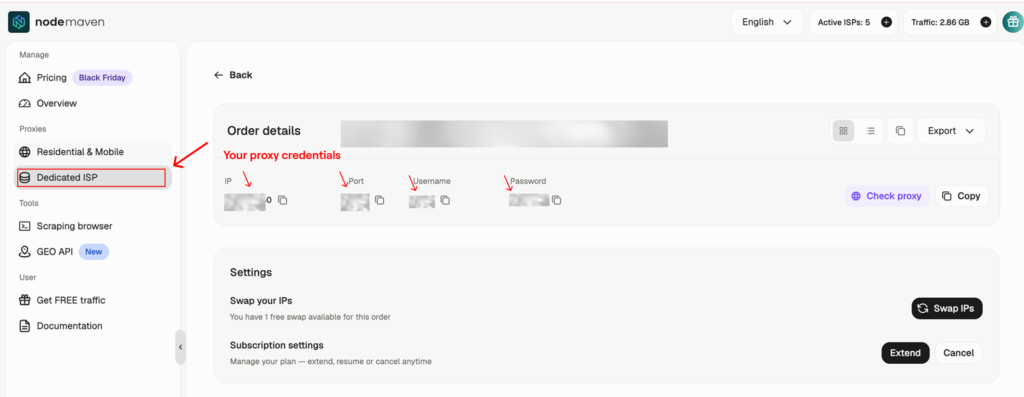
- Configure the browser or client. Follow the Chrome proxy configuration guide for browser requests or the Proxifier guide for TCP application routing. For permitted mobile workflows, use the Happ integration guide to add a SOCKS5 connection. For ISP proxies, enter your assigned IP and port rather than the rotating gateway shown in some examples. More setups are available in the integrations directory.
- Check for IP leaks. Open the NodeMaven Connection Checker in the configured environment. Confirm the expected HTTP exit and compare the WebRTC and available UDP results. If your direct public IP appears, correct the routing before starting work. Proxifier routes TCP; UDP requires a compatible client and configuration.
If the micro1 interview won’t load, follow its official troubleshooting steps, including checking extensions and network filters.
For projects that permit proxies, NodeMaven ISP proxies give you a dedicated, quality-checked static address with unlimited traffic and TCP/UDP support through compatible clients. From $2.33/IP/30 days with code ISP25 for new users when buying 2+ IPs.
Is micro1 worth applying to?
micro1 is worth considering if its projects fit your professional knowledge or everyday experience with AI tools. The $150 to $180/hour hematology role and $100 to $170/hour physics roles target domain experts. The short evaluator project offers up to $70/hour to generalists, but schedules only about 7.5 hours of work.
Language and generalist projects offer other ways in, but contributor reports describe both paid assignments and long gaps between projects. Treat micro1 as supplementary income until you have an active assignment and can assess its workload and payment terms.
Apply selectively, use reusable certification where available, and judge the first approved assignment by the payment and time it actually required. If the available jobs don’t match your background, our guide to AI training platforms that pay offers a broader shortlist. For recording-focused work, the Babel Audio review provides another comparison.


