
The Best AI Web Scraping Stack in 2026


Trying to figure out which AI scraping tools are actually worth building on in 2026, and which ones are just a traditional scraper with an LLM bolted on?
This is for developers and data teams choosing an AI-powered scraping stack, pulled together from what practitioners are discussing and testing right now, cross-checked against each tool’s own documentation and pricing.
What actually separates these tools
Before ranking anything, three questions decide whether an AI scraping tool holds up past the demo:
- Does it generate a full scraper, or just format what you already fetched? Some tools (ScrapeOps, ScrapeGraphAI) run the whole pipeline — fetch, render, extract. Others (LLM Scraper, Scrapy-LLM) are a layer you drop into a pipeline you already own.
- What happens on messy, non-obvious markup? Nested divs, accordions, and inconsistent layouts are where AI extraction tools most often start guessing instead of reading, worth testing on your actual worst-case page, not the vendor’s demo.
- Where does the proxy come from? Every one of these tools either fetches through its own bundled proxy pool (usually marked up) or expects you to bring one. That single fact affects your real cost more than any feature on the list.
AI web scraping stack in 2026: reviewed by Nodemaven team
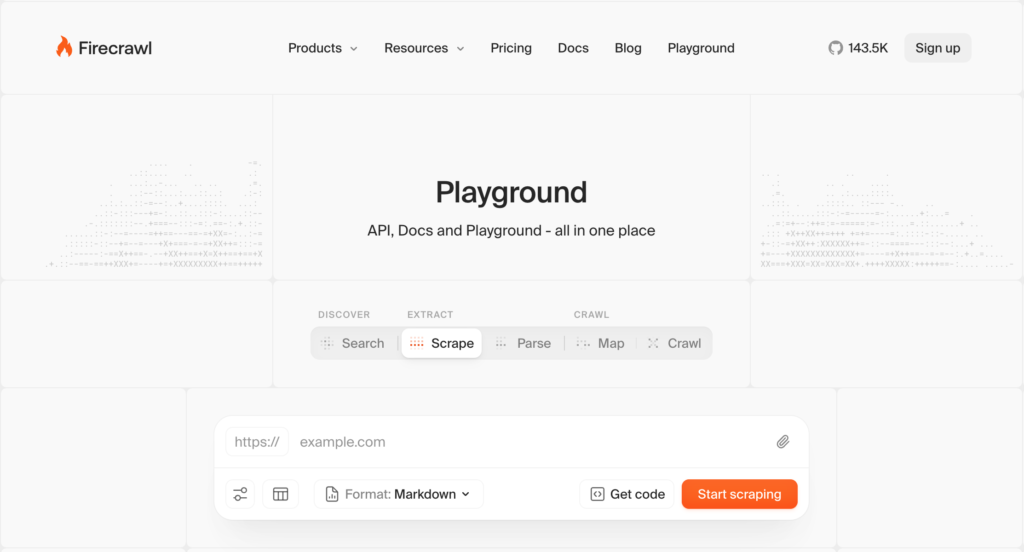
Firecrawl
Turns any URL into clean markdown or structured JSON, purpose-built for LLM and RAG pipelines, with native LangChain/LlamaIndex integration and an MCP server for AI coding agents.
It’s the easiest tool here to get started with, and extraction quality on straightforward pages is genuinely strong.
The catch is the credit system: a standard scrape is 1 credit, but Stealth Mode, which you need the moment a target runs Cloudflare-style protection — jumps to 5 credits per page, and AI-powered extraction runs 5 credits too.
A crawl-then-extract workflow can hit 7 credits per page, not 1, which is the single most common surprise reported by teams once they check their actual bill against the headline $16/month price. Pricing is subscription-only, and unused credits don’t roll over.
Best for: AI/RAG products that need clean text from arbitrary URLs, fast.
ScrapeGraphAI
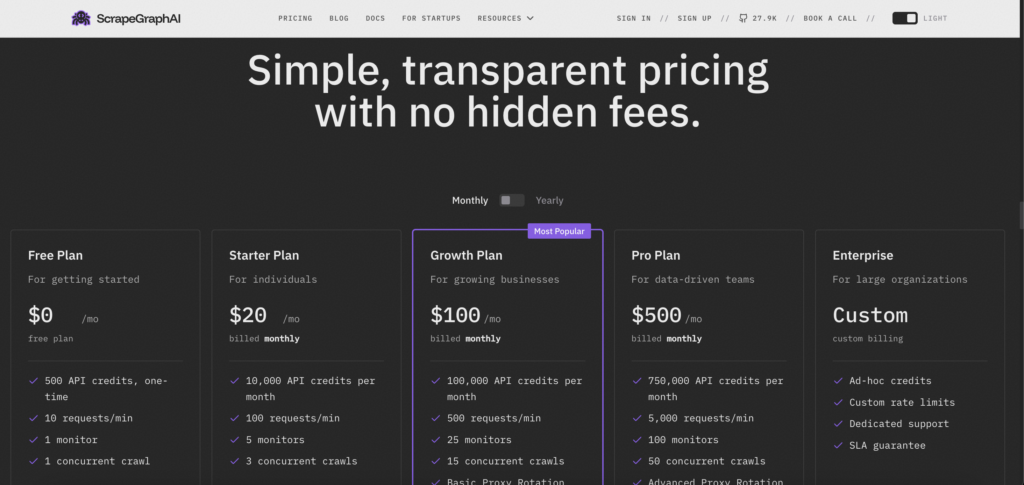
An AI-first platform built around a simple idea: describe what you want in a prompt, and a graph-based pipeline turns the page into typed, schema-validated JSON.
Because it reasons about page structure semantically rather than matching fixed selectors, it’s built to keep working when a site shifts a price element’s position or renames a CSS class, the exact failure mode that breaks traditional scrapers.
The tradeoff is cost per page. Estimates put SmartScraper around $0.021/page versus Firecrawl’s roughly $0.004/page for comparable extraction.
You’re paying for an LLM call on every single request, and that adds up fast at real volume. It’s also more developer-oriented than beginner-friendly; if you want a visual, no-code tool, this isn’t it.
Best for: Developers who want typed, validated JSON output and can absorb the per-page LLM cost.
ScrapeOps
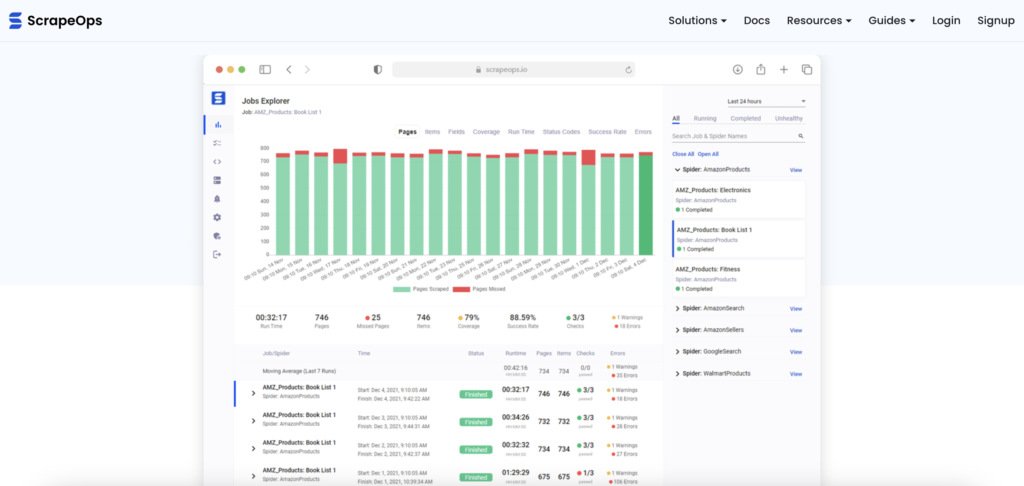
Less an AI extraction tool and more an AI-assisted scraper generator: give it up to five product-page URLs, pick Python or Node.js and a library, and it analyzes the page structure and writes a complete, working scraper, including a self-healing step that tests the code against real page data and auto-fixes fields that come back wrong.
This is genuinely closer to production-ready than most tools on this list. But it generates the extraction code, not the infrastructure underneath it. You’re still responsible for setting up your own proxy and handling rate limits once the generated scraper goes live. The AI layer removes maybe a fifth of the total workflow, and the infrastructure layer is still the other four-fifths.
Best for: Teams that want a real starting scraper generated for a known page type (product, search, category) rather than writing one from scratch.
Crawl4AI
The open-source answer to Firecrawl — 60K+ GitHub stars, Apache 2.0, built specifically to output clean markdown for RAG and agent pipelines, with CSS, XPath, or LLM-based extraction strategies.
No credit system, no vendor lock-in, and independent benchmarking shows it running several times faster than Firecrawl on comparable jobs.
The tradeoff is exactly what you’d expect from open source: no managed service. You own the infrastructure: proxies, scaling, retries, and keeping up with whatever a target site changes. That’s the correct tradeoff for teams with real Python/DevOps capacity who don’t want per-request billing; it’s the wrong one if you want something that works out of the box with zero ops.
Best for: Developers who want full control and are comfortable owning the operational side.
LLM Scraper & Scrapy-LLM
Both are libraries rather than platforms.
They slot LLM-based extraction into a scraping stack you already have (Node/TypeScript for LLM Scraper, Python/Scrapy for Scrapy-LLM), instead of replacing it. Full Playwright support in LLM Scraper makes it a reasonably popular choice for teams already comfortable in that ecosystem.
Both remain dependent on an external LLM for the actual extraction step, so you inherit the same prompt-tuning and edge-case handling as any AI extraction tool.
Best for: Teams already running Scrapy or a Node scraping stack who want to add AI extraction without switching platforms.
AutoScraper Library (GitHub )
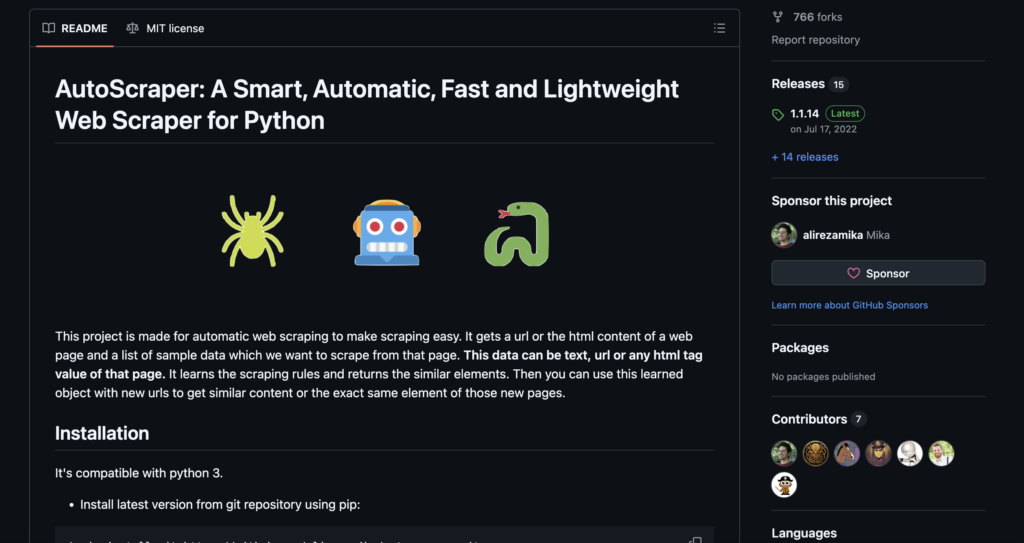
A lightweight, open-source library that uses small local models to keep compute cost down. You define the items you want once, and it learns to find similar patterns on the target site. Fast to set up, genuinely useful for quick prototypes and one-off jobs.
It’s consistently flagged as not built for larger production workloads. Treat it as a fast way to validate an idea before committing to a heavier tool.
Best for: Quick prototypes and one-off extraction jobs, not ongoing production scraping.
Browse AI
A no-code, visual platform.
You record yourself clicking through a page once, and the robot learns the pattern and repeats it on a schedule, adapting automatically to minor layout shifts (a moved button, a new popup). Proxies and scheduling are handled for you.
It’s built for recurring, non-technical extraction jobs. Reliability over redesigns matters more here than raw speed or one-off scale. It’s not the right tool for a single large one-time crawl.
Best for: Non-technical teams monitoring the same pages repeatedly over time.
Octoparse
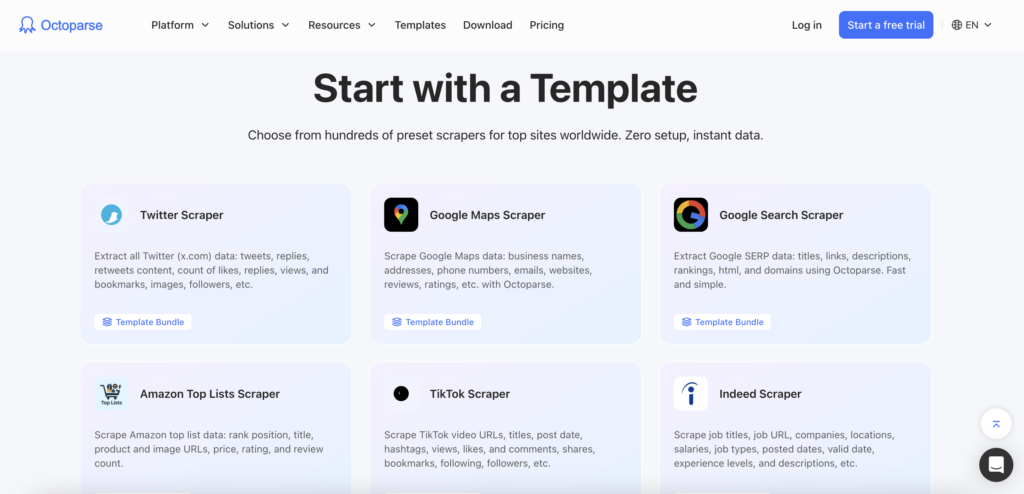
A visual, no-code scraper with AI auto-detection of data fields, 600+ ready-made templates, and cloud execution with IP rotation and CAPTCHA solving built in. Genuinely useful on sites that actively fight back with infinite scroll or aggressive anti-bot layers.
Pricing starts around $69-89/month, and proxy/CAPTCHA usage bills separately on top of that ($3/GB for residential proxies, per independent pricing breakdowns), worth budgeting for before you commit, since the base subscription doesn’t cover it.
It’s also Windows/Mac only, with no Linux support for the workflow builder.
Best for: Non-technical teams facing genuinely hostile targets that simpler no-code tools can’t handle.
Apify
A marketplace of 35,000+ pre-built Actors covering most major platforms (Instagram, Amazon, Google Maps, LinkedIn), plus the open-source Crawlee SDK if you want to build your own. Several Actors now layer AI extraction on top of the underlying scrape.
The most commonly reported budget surprise: residential proxy bandwidth, billed separately at roughly $8/GB.
A single JavaScript-heavy run against a protected target can burn through a $29 Starter plan’s entire credit allotment in days, the compute-unit pricing on the platform page looks cheap until that line item shows up.
Best for: Scraping a known platform without building anything, or orchestrating a multi-step pipeline with ready-made building blocks.
steel.dev
An open-source, cloud-native browser API purpose-built for AI agents.
Spin up real Chrome sessions programmatically, keep them alive for up to 24 hours, and connect via Playwright, Puppeteer, or Selenium without managing browser infrastructure yourself. It’s reported to cut LLM token usage significantly by returning cleaner extracted content instead of raw page dumps.
It’s a browser-and-session layer, not an extraction tool. You still pair it with your own AI parsing step (or another tool on this list) on top. Proxy bandwidth and CAPTCHA solving are metered separately by usage tier.
Best for: Agentic workflows that need real, persistent browser sessions rather than one-shot page fetches.
Where you’ll need proxies
| Tool | Proxy bundled? | What’s already offered | Can you bring your own (BYO)? | Verdict |
|---|---|---|---|---|
| Firecrawl | Yes | Bundled into subscription. Stealth Mode = 5 credits/page instead of 1 | No, proxy is baked into the architecture, no option to swap in your own | Can’t bring your own. If targets are protected, you pay the 5x multiplier, no way around it |
| ScrapeGraphAI | Yes | Bundled into the per-page LLM cost (~$0.021/page) | No, proxy is part of the managed pipeline | Same as Firecrawl, the markup is baked into the price, no way to bypass it |
| ScrapeOps | No (in the AI Scraper Builder) | Generates scraper code only, proxy not included | Yes, required | Without proxy, the generated scraper won’t get past detection |
| Crawl4AI | No | Open-source, self-hosted, no infrastructure included at all | Yes, required | 100% needs your own |
| LLM Scraper / Scrapy-LLM | No | Library, not a platform | Yes, required | Proxy is entirely on you |
| AutoScraper | No | Local library | Yes, required | You can skip it for light prototypes on easy targets, but anything more serious needs proxy |
| Browse AI | Yes | Bundled, no visibility or control | No | Baked into the plan |
| Octoparse | Partial | Bundled on cloud runs, but billed separately ($3/GB) | Only in local mode (uses your own IP for free) | You’re locked into their $3/GB, no BYO |
| Apify | Yes, as an add-on | Residential proxy add-on ~$8/GB | Yes, many Actors let you set a custom proxy group | You technically can bring your own, but check the specific Actor first |
| steel.dev | Yes | Proxy bandwidth metered by plan tier | Not publicly documented | Most likely baked into the session infrastructure, same as Firecrawl/Browse AI |
Choosing your stack (quick guide)
| If you… | Use | Note |
|---|---|---|
| Are building an AI/RAG product and need clean markdown fast | Firecrawl | Budget for the Stealth Mode multiplier |
| Want typed, validated JSON that survives layout changes | ScrapeGraphAI | Only if the per-page LLM cost fits your volume |
| Want a real generated scraper for a known page type | ScrapeOps | Budget separately for the high-quality proxy |
| Want more control over your tools and don’t want to overpay for bundled proxies | Crawl4AI or LLM Scraper/Scrapy-LLM | Pair it with NodeMaven residential proxies, they match well on speed. Check your expected usage with our free proxy checker → |
| Run non-technical, recurring monitoring jobs | Browse AI | — |
| Face hostile targets and need no-code | Octoparse | Budget for proxy/CAPTCHA add-ons |
| Target a known platform and don’t want to build anything | Apify | Check residential proxies |
| Already have extraction logic, just need reliable access | ScraperAPI | — |
| Need agent workflows with real browser sessions | steel.dev | — |
So, what’s the best AI scraping stack in 2026?
Nobody’s picking a single best tool anymore. The teams that seem happiest with their setup are splitting the job into two separate decisions and shopping for each one on its own terms.
The first decision is extraction, and here, AI genuinely earns its reputation. A prompt that adjusts when a site quietly renames a CSS class beats a selector that snaps the same afternoon. Whether that’s Firecrawl’s markdown, ScrapeGraphAI’s typed JSON, or something self-hosted like Crawl4AI or LLM Scraper comes down to your budget and how much infrastructure you actually want to own.
The second decision is the one that quietly decides your whole bill: getting the request through in the first place. And here’s what surprised us most going through this — nothing about the AI era of scraping touched this part at all. It’s still, plainly, a proxy problem.
So yes, scraping really is shifting toward AI extraction, and that shift isn’t slowing down. But it hasn’t made the internet any less protective of its pages. The stack that actually wins in 2026 is the one that treats extraction and access as two separate problems, not the one tool promising to solve both at once.


