
Temu Scraper: 5 Tools and Methods to Extract Product Data



Temu lists millions of products, with prices, discounts, ratings, reviews, and category details attached to each one. Collecting this information by hand is slow, especially across categories or over time. A Temu scraper automates the process and turns product pages into structured data you can actually use.
There are several ways to do it. You can use a ready-made scraper, a no code tool, a scraping API, or write your own script. In this guide we will compare the main options, explain what data you can collect, and see when proxies become useful for Temu scraping.

Scrape Temu at scale with reliable proxies
Get residential and mobile proxies from $3.50 with 750MB of bandwidth included
What is a Temu scraper?
A Temu scraper is a tool or script that collects publicly available product information from Temu and turns it into structured data, like a spreadsheet or a JSON file.
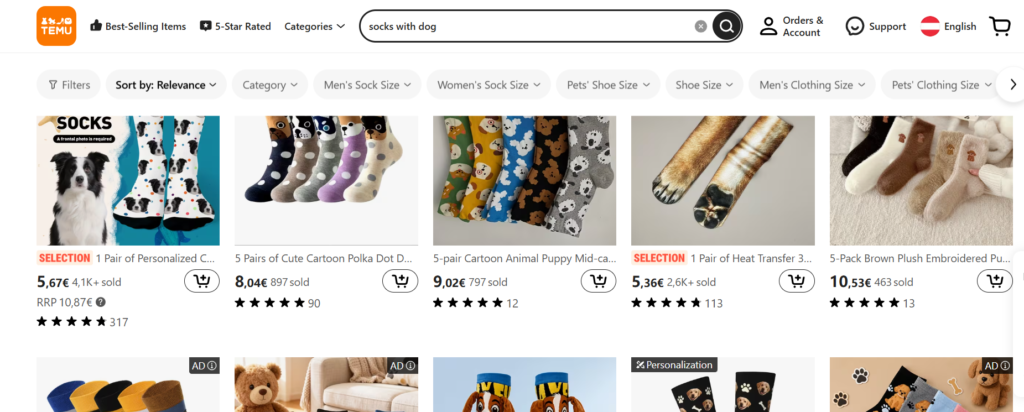
Depending on the scraper, it can collect:
- Product names
- Prices and original prices
- Discounts
- Ratings
- Review counts and review text
- Product URLs
- Product images
- Категории
- Seller or store information
- Other publicly listed product attributes
Not every scraper extracts every field. The available data depends on the tool you use and how Temu structures its pages at any given time. Some tools only cover search result listings, others also scrape individual product pages for more detail, such as reviews and variants.
What can you use Temu scraping for?
- Product research
Find trending products in a category before deciding what to sell or promote
- Мониторинг цен
Track price changes and discounts on specific products over time
- Исследование конкурентов
See what similar sellers are listing and how they price their products
Study category structures, best sellers, and product positioning
- Finding products by category
Pull structured lists instead of scrolling through pages manually
- Tracking ratings and reviews
A Temu review scraper can show how ratings and review volume change for a product or store over time
Combine product and pricing data to spot patterns across a niche
Need proxies for your Temu scraper?
Start with NodeMaven residential or mobile proxies from $3.50 and get 750MB of bandwidth
5 Temu scrapers and tools compared
| Инструмент | Тип | Лучшее для | API | Простота использования |
| Apify Temu Scraper | Ready-made Actor | Developers who want structured data via API | Да | Умеренный |
| Bright Data | Managed scraping solution | Teams that want data without building scrapers | Да | Easy to moderate |
| Octoparse | No-code visual scraper | Non-technical users who want a template | Ограниченный | Легко |
| Thunderbit | AI browser extension | Quick one-off scrapes with no setup | Нет | Очень легко |
| Custom scraper | Self-built script | Developers who need full control | Depends on your build | Requires coding |
1. Apify Temu Scraper
Apify is a scraping platform that hosts many independently built Actors, small scraping programs anyone can run. There is no single official Apify Temu scraper. Instead, several community developers publish their own Apify Temu scraper actors, with names like Temu Scraper и Temu Products Scraper.
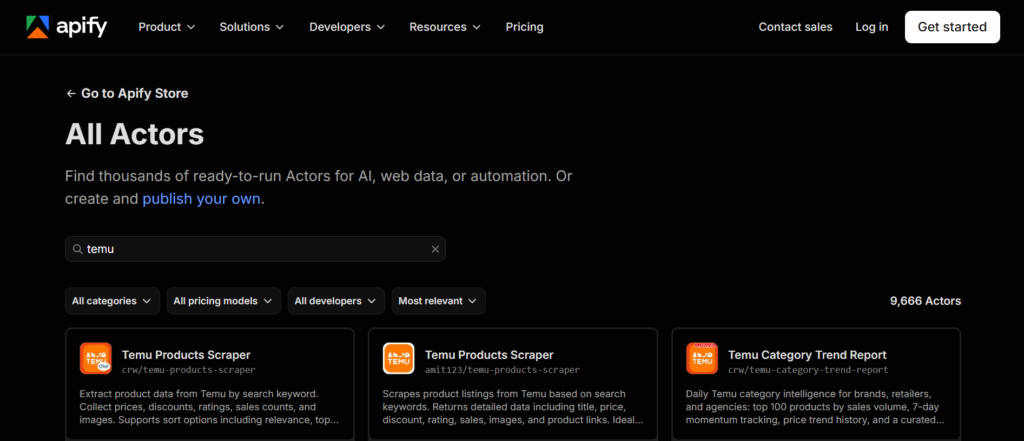
Coverage varies. Some collect product titles, prices, discounts, ratings, review counts, images, and store details from search results. Some also scrape individual product pages for extra fields, like variants and video URLs.
Each Actor runs through the Apify platform, so you can call it from the web console, or through the Apify API to automate runs. No coding is required to use one, though setting up input fields such as keywords, categories, or URLs takes a little getting used to for total beginners.
Pricing is usage-based, since most of these Actors charge per result. Rates among current Temu Actors range from about $1.20 към $10.00 per 1,000 results, depending on the developer and the amount of data each result includes. Apify also offers free credits for new accounts to test an Actor first.
This route works best for people comfortable comparing a few Actors before picking one, rather than expecting a single official product.
2. Bright Data Temu Scraper
Bright Data offers a dedicated Temu scraping solution for collecting data such as products, prices, companies, and categories. It combines a no-code AI scraper builder with managed data collection options.
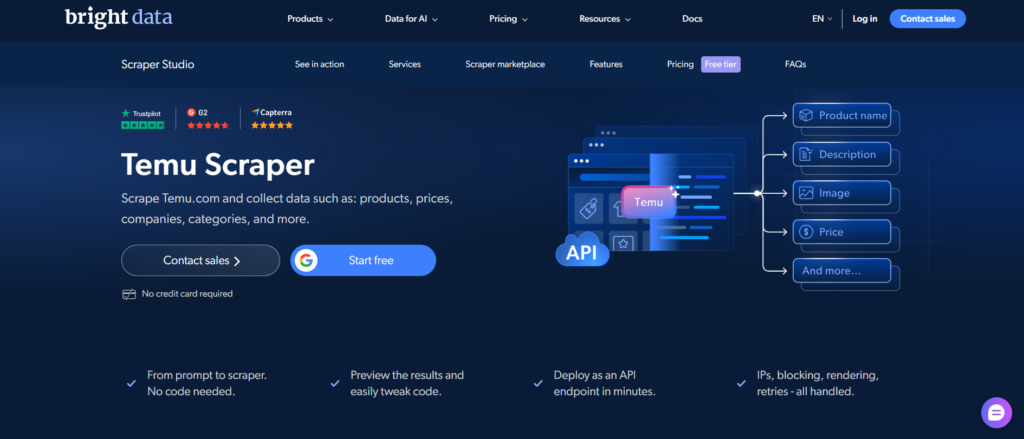
With the AI scraper builder, you describe the data you need in plain English. Bright Data then generates a scraper that you can test, adjust, and deploy as an API endpoint. You can also edit the generated code in its built in IDE if needed.
Также есть managed option for teams that do not want to handle the technical side. Bright Data can build, maintain, and monitor the scraper, while the user receives the collected data.
The current Scraper Studio pricing includes 5,000 free page loads per month. Pay-as-you-go pricing starts at $1.50 per 1,000-page loads.
Bright Data is a good for teams that need Temu data at scale without managing infrastructure themselves.
3. Octoparse
Octoparse is a no code scraping tool built around visual workflows. Instead of writing selectors or code, you select elements on a webpage and build an extraction workflow through its visual interface.
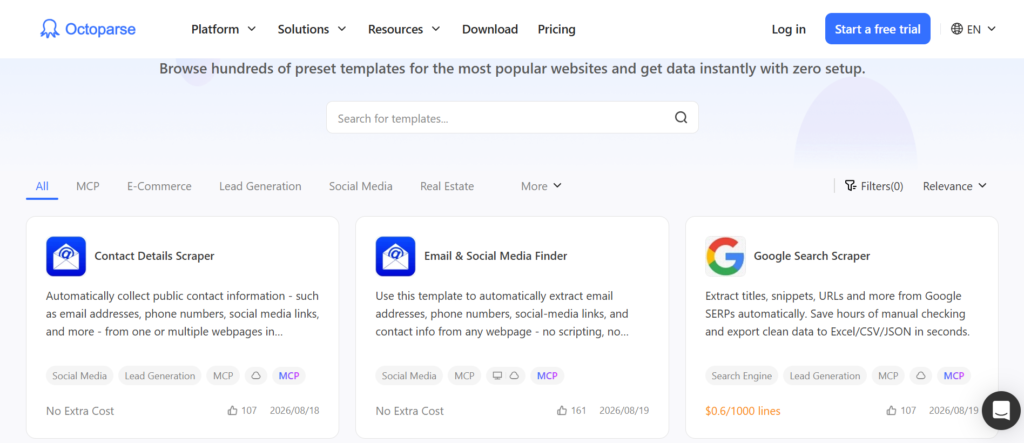
You can start with a ready-made template or create a custom task. Octoparse also supports automatic detection to help identify page elements and build a scraping workflow. If no suitable template is available, you can create your own task and define the data you want to collect.
You can export extracted data to Excel, CSV, HTML, JSON, XML, databases, and cloud storage. Octoparse also provides an API for exporting cloud data and managing scraping tasks.
Octoparse is a good fit for non-technical users who want a visual scraping workflow without writing code. It also works well when you need to customize the fields you collect instead of relying on a fixed scraper.
4. Thunderbit
Thunderbit is a Chrome extension that uses AI to scrape data from any webpage, including Temu product and category pages. Instead of selecting fields manually, you open a Temu page, and Thunderbit’s AI agent suggests fields to extract, such as title, price, rating, and reviews. You can also scrape subpages, so product detail fields get added automatically after an initial listing scrape.
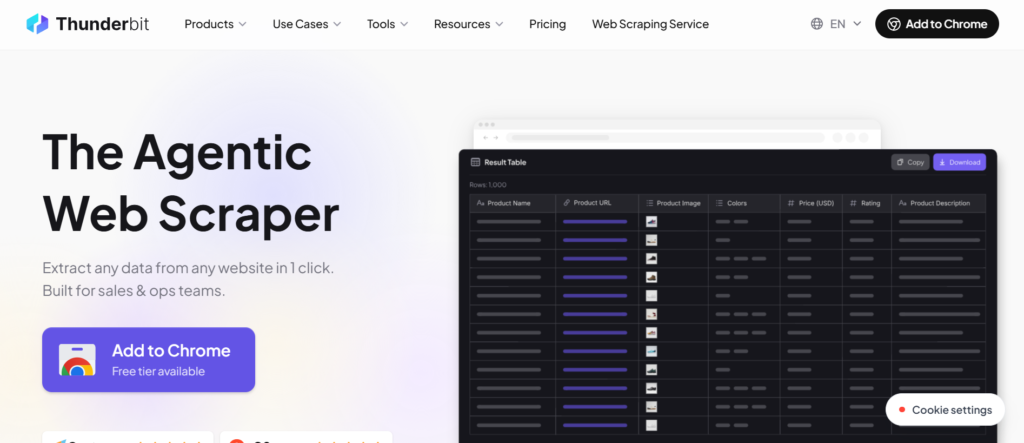
Results export to Excel, Google Sheets, Airtable, or Notion. No coding or selector setup is required at any point.
Thunderbit offers a free tier with a limited number of pages per month, currently around 6 pages with a credit limit per page. Paid plans start at roughly $9 to $15 a month for higher page and credit limits, billed monthly or yearly.
This tool works best for people who want a quick Temu scrape without installing software or setting up an account with a full scraping platform.
5. Build your own Temu scraper
If you are comfortable with code, you can build a custom Temu scraper. Common tools include Python with Requests and BeautifulSoup, or browser automation tools such as Playwright and Selenium. Our guide to веб-скрапинг на Python covers these tools and the basic workflow in more detail.
A custom scraper gives you control over the data fields, request logic, output format, scheduling, and proxy configuration. For larger jobs, ротационные резидентские прокси can help distribute requests across different IP addresses.
The tradeoff is maintenance. E-commerce sites change their page structure and anti-bot protections over time. A scraper that works today may need updates later if selectors or page behavior change.
This approach is best for developers who are prepared to maintain their scraper over time.
How to choose a Temu scraper
- Choose a no code tool if you want to collect data without programming, and a template or AI assisted extension already covers your needs.
- Choose an API if you want to plug scraped data into your own application, dashboard, or workflow, rather than exporting files manually.
- Choose an Apify Actor if you want a ready-made scraper with API access and configurable input, without building the extraction logic yourself.
- Build your own scraper if you need full control over data fields, scheduling, and proxy setup, and you are ready to maintain the script over time.
Collect Temu data without relying on one IP
Use rotating residential and mobile proxies from $3.50 with 750MB of bandwidth included
Do you need proxies for Temu scraping?
A scraper that sends many requests from one IP address can run into rate limits or access issues, especially at higher volumes. Proxies let you spread requests across different IP addresses instead of relying on one.
Whether you need proxies, and how many, depends on your scraping volume and workflow.
Резидентские прокси
Резидентские прокси use IP addresses tied to real residential internet connections. They give scrapers a large pool of IPs and broad geographic coverage. For a Temu scraper sending many requests, ротационные резидентские прокси can help distribute traffic more naturally than a single IP.
Мобильные прокси
Мобильные прокси use IP addresses tied to mobile carrier networks. They can be useful when a workflow needs a higher trust IP type, or when residential IPs are not performing well for a specific task.
Using NodeMaven for Temu scraping
NodeMaven is a proxy provider offering both residential and mobile proxies through one dashboard and one pricing structure. For a Temu scraping workflow, this matters because different tasks can call for different IP types.
You can start with ротационные резидентские прокси for regular product or price scraping, since residential proxies offer a large IP pool and broad country coverage. If certain requests perform better through mobile IPs, you can switch proxy type in the same dashboard.
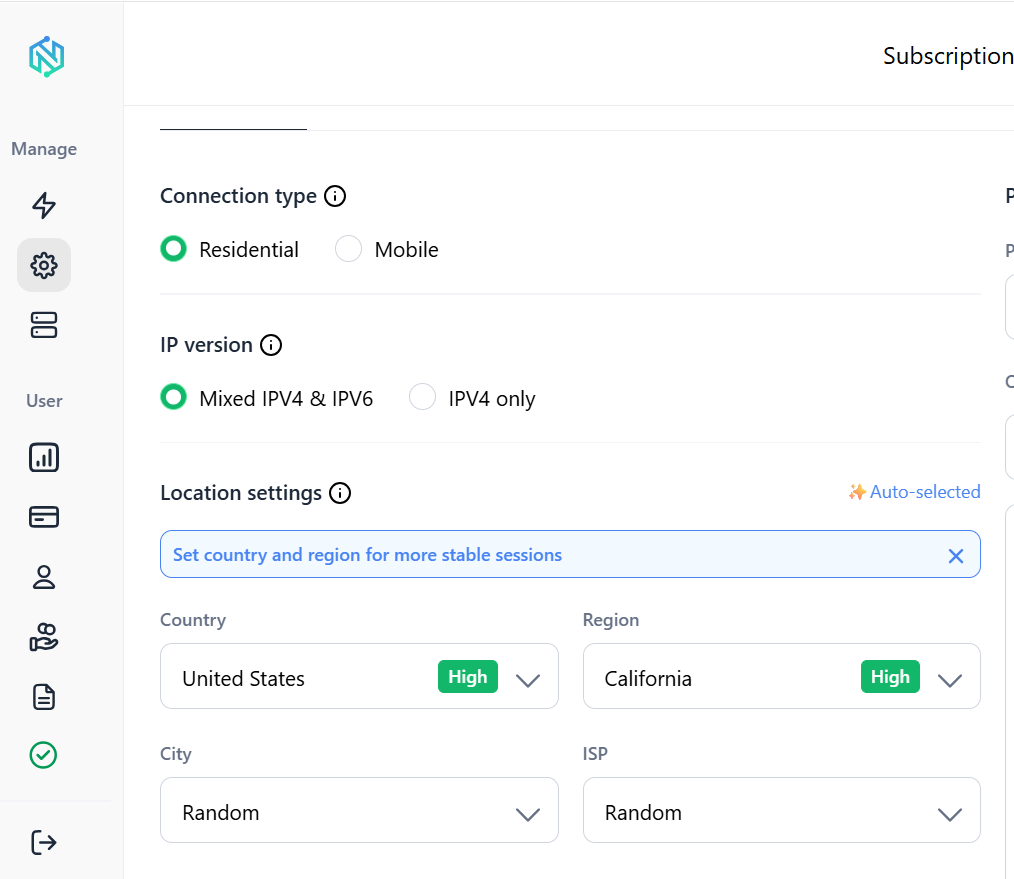
NodeMaven supports country, city, and Таргетинг на уровне ZIP. Its IP quality filter screens IPs before they are assigned to a session, based on fraud score and reputation signals.
Both residential and mobile traffic draw from the same balance, so you are not managing separate plans for each proxy type.
Temu scraper API: is it worth using?
A Temu scraper API lets you send a URL, keyword, or search request and get back structured data, without managing browsers, parsing HTML, or handling proxies yourself. The API takes care of the scraping logic on its end.
This approach makes sense for:
- Applications that need Temu data automatically, without a person running a task
- Scheduled data collection, like daily price checks
- Large scale projects covering many products or categories
- Teams that do not want to build or maintain scraping infrastructure
Compared to building your own scraper, an API trades some control for less maintenance. You do not choose exactly how requests are made or how selectors are handled, but you also do not need to fix the scraper when Temu’s page structure changes.
Temu scraper GitHub options
Searching Temu scraper on GitHub turns up a number of open-source projects, mostly built with Python and libraries like Requests, BeautifulSoup, or Selenium. It can be useful for learning how other developers approach Temu scraping, or as a starting point for your own script.
But many of these repositories are small, personal projects rather than actively maintained tools.
If you are evaluating a GitHub repository for a Temu scraper, check when it was last updated and whether the author is still responding to issues before relying on it for anything beyond learning or experimentation.
Заключение
The right Temu scraper depends on your technical skills, the scale of data you need, and how often it should be refreshed. A no code tool like Octoparse or Thunderbit works well for simple, one off projects. A scraping API suits automated or scheduled workflows. A custom scraper gives developers the most control, at the cost of ongoing maintenance.
If proxies become part of the setup, residential proxies are a starting point for most Temu scraping tasks, while mobile proxies can help with workflows that need a different type of IP. NodeMaven is one option for accessing both residential and mobile proxies from a single dashboard, useful if a workflow needs to switch between IP types without adding a separate provider.
Ready to scale your Temu scraper?
Try NodeMaven residential and mobile proxies from $3.50 and get 750MB of bandwidth to start


