
Residential VPN vs. Residential Proxy: everything you need to know before choosing one




Many people looking for better online privacy, unrestricted access, and improved anonymity come across two similar terms: residential VPN and residential proxy. Since both use residential IP addresses and help mask your real location, it’s easy to assume they are the same thing.
However, a residential VPN and a residential proxy are designed for different purposes and offer different advantages. While both can help you access geo-restricted content and hide your IP address, one may be a better fit depending on how you plan to use it.
In this guide, we’ll explain what a residential VPN is, how a residential proxy works, and which solution is best for your personal or business needs.

Need residential IPs instead of a residential VPN? Get 750 MB trial traffic for just $3.50
Residential VPN vs. residential proxy: quick comparison
Before diving into the details, here’s a quick overview of the key differences.
| Feature | Residential VPN | Residential Proxy |
| Uses residential IPs | Yes 🟢 | Yes 🟢 |
| Encrypts traffic | Yes 🟢 | No 🔴 |
| Hides your IP address | Yes 🟢 | Yes 🟢 |
| Supports IP rotation | Limited 🟡 | Yes 🟢 |
| Suitable for web scraping | Limited 🟡 | Excellent 🟢 |
| Good for streaming | Yes 🟢 | Yes 🟢 |
| Good for multi-account management | Limited 🟡 | Excellent 🟢 |
| Connection speed | Good 🟢 | Excellent 🟢 |
Both options provide access to residential IP addresses, but the way they handle traffic and online activities is very different.
What is a residential VPN?
A residential VPN is a virtual private network that routes your traffic through a residential IP address assigned by an internet service provider (ISP). Unlike traditional VPNs that often rely on datacenter IPs, a residential IP VPN allows users to browse the internet through an IP address associated with a real household connection.
Like any VPN, a residential VPN encrypts your internet traffic and creates a secure tunnel between your device and the VPN server. Understanding different VPN protocols can also help users choose the right level of security, speed, and compatibility for their specific browsing needs. This helps protect your browsing activity from snoopers, advertisers, and cybercriminals.
A VPN with residential IP functionality combines the privacy benefits of a VPN with the authenticity of residential IP addresses. Because residential IPs appear more legitimate to websites, they are generally less likely to be flagged than datacenter VPN addresses.
Benefits of a residential VPN
Residential VPNs offer several advantages:
- Enhanced online privacy
- Encrypted internet traffic
- Access to geo-restricted content
- Residential IP addresses that look like regular users
- Better success rates than traditional VPNs in some situations
For users primarily focused on private browsing and secure internet access, a residential VPN can be a useful solution.
What is a residential proxy?
A residential proxy is an intermediary server that routes your requests through a residential IP address. Instead of creating an encrypted tunnel like a VPN, a residential proxy simply forwards your traffic through another IP address before it reaches the target website.
Because residential proxies use IP addresses issued by real ISPs, they are highly trusted by websites and online services. This makes them particularly effective for tasks that require scale, automation, or precise location targeting.
Many residential proxies also support IP rotation. This means the IP address can change automatically between requests or sessions, making it much harder for websites to identify automated activity.
Benefits of residential proxies
Residential proxies are widely used for:
- Web scraping
- Market research
- Price monitoring
- Ad verification
- SEO monitoring
- Social media management
- Multi-account workflows
- Accessing geo-restricted websites
For businesses that need large-scale data collection or account management capabilities, residential proxies are usually the preferred choice.
Compare residential VPNs to premium residential proxies. Try 750 MB of residential traffic for only $3.50
How does a VPN with a residential IP work?
Many users search for terms like “residential IP VPN” because they want the advantages of a VPN without using easily identifiable datacenter addresses.
The process is relatively simple:
- You connect to the VPN.
- The VPN encrypts your traffic.
- Your traffic exits through a residential IP address.
- Websites see the residential IP instead of your real IP.
As a result, your activity appears to come from a regular internet user rather than a traditional VPN server.
This approach can help improve access to websites that aggressively block standard VPN traffic.
Residential VPN vs. residential proxy for web scraping
When it comes to web scraping, residential proxies are generally the better option.
Web scraping often requires thousands of requests to target websites. Most residential VPNs are not designed for this level of activity and usually provide only a single IP address at a time.
Residential proxies, on the other hand, offer:
- Large residential IP pools
- Automatic IP rotation
- Session control
- Location targeting
- Higher success rates
Because websites frequently detect and limit repetitive requests, rotating residential proxies are far more effective for scraping large amounts of data.
For businesses performing competitor research, SERP monitoring, or market intelligence gathering, residential proxies remain the industry standard.
Residential VPN vs. residential proxy for social media management
Managing multiple social media accounts requires maintaining unique online identities and avoiding suspicious activity patterns.
A residential VPN can help hide your location and secure your connection, but it usually lacks the flexibility required for managing multiple accounts at scale.
Residential proxies provide more control over:
- IP assignment
- Geographic targeting
- Session persistence
- Browser profiles
- Account separation
This makes residential proxies a popular choice for agencies, marketers, and businesses managing multiple online accounts.
Residential VPN vs. residential proxy for streaming
Both residential VPNs and residential proxies can help users access content that may not be available in their region.
Streaming platforms often restrict access based on geographic location. Since both solutions use residential IP addresses, they can help users appear as though they are browsing from a supported country.
However, residential VPNs have one important advantage: encryption.
Because a residential VPN protects all traffic on the device, many users prefer it for streaming, browsing, and general online privacy.
If your primary goal is watching content from different locations, a residential VPN may be the more convenient option.
Are free residential VPNs worth using?
Searches for free residential VPN continue to grow as users look for affordable ways to improve privacy and access restricted content.
However, free services often come with significant limitations.
Common drawbacks include:
- Limited bandwidth
- Slower speeds
- Small IP pools
- Security concerns
- Data collection practices
- Frequent connection interruptions
Some free residential VPN providers rely on peer-to-peer networks, where users effectively share their connections with others. While this can reduce costs, it may also introduce privacy and performance concerns.
For users who need reliability and security, premium services are usually a safer option.
Scale web scraping, automation, and account management with premium residential proxies. Get 750 MB for $3.50
Best residential VPN alternatives
If you’re looking for the best residential VPN solution, you’ll likely encounter providers such as “Tuxler” and other services offering residential IP VPN products.
However, it’s important to evaluate your actual needs before choosing a provider.
If your goal is:
- Private browsing
- Secure connections
- Streaming
A residential VPN may be sufficient.
If your goal is:
- Web scraping
- Data collection
- Social media management
- Ad verification
- Large-scale automation
Residential proxies are often the more effective solution.
The right choice depends on how you plan to use residential IP addresses.
Why businesses choose NodeMaven residential proxies
NodeMaven provides access to a premium residential proxy network designed for data collection, market research, social media management, ad verification, and other business-critical tasks. Unlike a residential VPN, which typically routes all traffic through a single residential IP, NodeMaven allows users to access a large pool of residential IPs with advanced rotation and session management options.
What makes NodeMaven different?
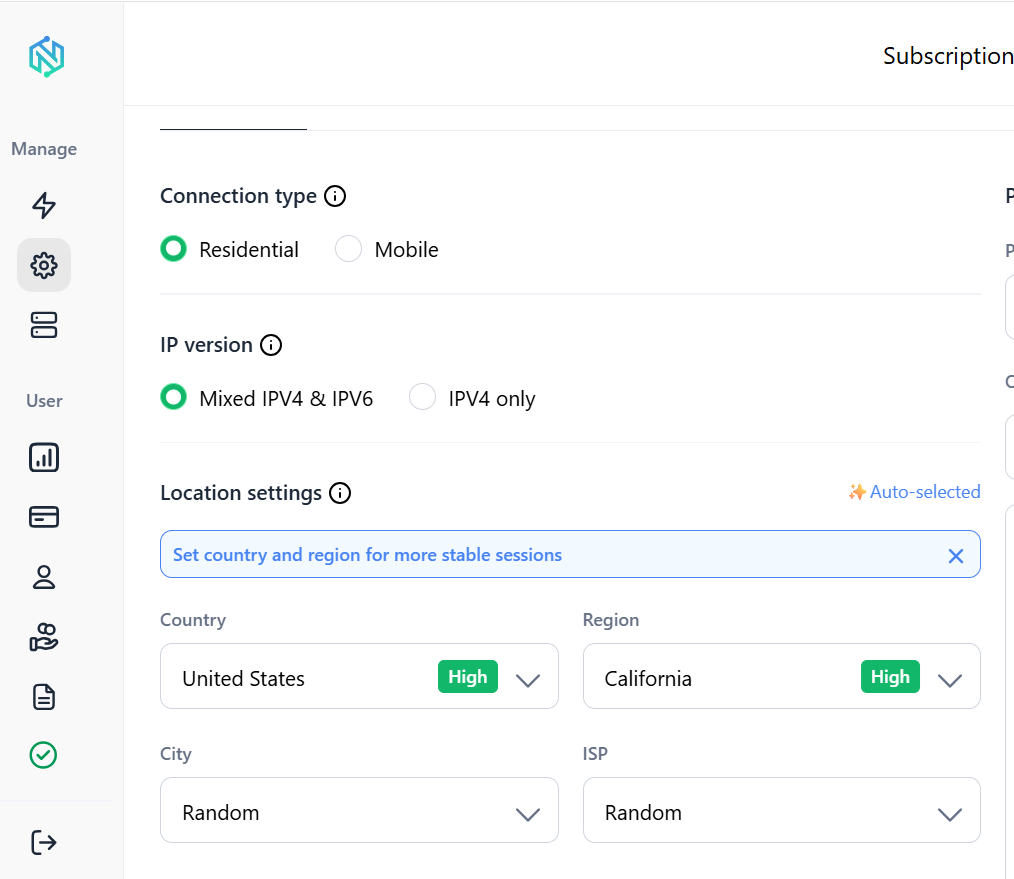
- Large pool of residential IPs
Access 30M+ real residential IP addresses from multiple locations worldwide to improve success rates and reduce the risk of blocks.
- Flexible IP rotation
Choose between rotating and sticky sessions depending on your use case. This makes NodeMaven suitable for both large-scale web scraping and long-term account management.
- Precise geo-targeting
Target 190+ specific countries, and 1400+ locations to gather localized data, verify ads, or test location-dependent services.
- Built for automation and data collection
Residential VPNs can help protect your privacy, but they aren’t optimized for large-scale operations. NodeMaven residential proxies are designed to support web scraping, competitor monitoring, SERP tracking, web automation, and other high-volume activities.
- Reliable performance
With fast response times and high-quality residential IPs, NodeMaven helps collect data efficiently while maintaining a natural online footprint.
Residential proxies often provide more flexibility than a residential VPN. For these use cases, NodeMaven offers a scalable solution built specifically for business needs.
Final thoughts
Choosing between a residential VPN and a residential proxy ultimately comes down to your goals.
A residential VPN is designed for privacy, encrypted browsing, and secure internet access. By combining VPN technology with residential IP addresses, it offers a practical solution for users who want additional privacy while maintaining a natural online presence.
Residential proxies, however, are built for flexibility and scale. They provide access to large pools of residential IPs, support rotation, and excel at tasks such as web scraping, market research, social media management, and automation.
If your priority is secure browsing, a residential VPN may be the right choice. If you need performance, scalability, and advanced IP management capabilities, residential proxies are the better option.