
Is web scraping legal in 2026? A complete guide to laws, compliance & best practices


Web scraping itself is not illegal. But how you scrape, what you collect, and what you do with it can quickly change that answer.
This guide breaks down the legal landscape in plain language, so you can scrape with confidence instead of guesswork.
This article is for informational purposes only and is not legal advice. Laws vary by country and change over time. Talk to a qualified attorney before making decisions that carry legal risk.

Build reliable web scrapers with premium residential and mobile proxies. Start with NodeMaven from $3.50 and get 750 MB included
Is web scraping legal?
Yes, web scraping is generally legal when you collect publicly available data without bypassing access controls, without violating a site’s terms of service through a binding contract, and without capturing personal data in ways that break privacy law.
Legality depends on four things: what data you collect, how you access it, where you and the website are based, and what you do with the data afterward. There is no single global law that answers the question for every case.
When is web scraping legal?
Scraping is typically low risk when it involves:
- Public data that anyone can view without logging in
- Content not protected by copyright, such as prices, stock levels, or factual listings
- Data collected respectfully, without hammering servers or ignoring rate limits
- Use cases like price comparison, SEO research, market analysis, or academic research
Courts in the US have repeatedly found that scraping publicly accessible data does not, by itself, break federal computer-fraud law. That was the core finding in both the hiQ v. LinkedIn and Meta v. Bright Data cases, covered below.
When can web scraping become illegal?
Personal data
Scraping names, emails, phone numbers, or other personally identifiable information can trigger privacy laws like GDPR or CCPA, even if the data is publicly visible. Publicly viewable does not automatically mean lawful to collect and reuse.
Copyrighted content
Original text, images, and creative work are typically protected by copyright. Scraping and republishing full articles, photos, or product descriptions may infringe copyright, even if the scraping method itself was technically allowed.
Database rights
Some regions, particularly the EU, grant separate legal protection to databases that required substantial investment to build. Extracting large portions of a protected database can violate these rights independently of copyright law.
Restricted access
Logging in, bypassing paywalls, ignoring CAPTCHAs, or circumventing technical blocks changes the legal picture. Courts have generally treated access to logged-in or password-protected areas far more seriously than access to open, public pages.
Quick legal checklist before scraping any website
| Question | Why It Matters |
| Is the data public, with no login required? | Publicly accessible data generally carries lower legal risk than restricted content. |
| Does it include personal data? | Personal information may be subject to GDPR, CCPA, or other privacy laws. |
| Is the content copyrighted creative work? | Republishing or reusing copyrighted material may infringe intellectual property rights. |
| Do the website’s Terms of Service prohibit scraping? | If the terms are legally binding, scraping may result in contractual liability. |
| Does the robots.txt file disallow crawling? | It is not legally binding, but ignoring it may support claims of unethical behavior. |
| Are you bypassing logins, paywalls, or CAPTCHAs? | Circumventing access controls significantly increases legal risk. |
| Are you sending too many requests to the server? | Excessive traffic may disrupt the website and support trespass or nuisance claims. |
| Will you resell, redistribute, or republish the scraped data? | Commercial use may introduce additional copyright, licensing, and contractual issues. |
Public data vs Personal data vs Copyrighted data
| Data Type | Example | General Legal Risk |
| Public data | Product prices, stock availability, public reviews, company information | Generally lower risk when collected responsibly |
| Personal data | Names, email addresses, phone numbers, user profiles, IP addresses | Higher risk. Privacy laws such as GDPR or CCPA may apply. |
| Copyrighted content | Articles, photographs, videos, original product descriptions, artwork | Higher risk. Copyright and intellectual property laws may restrict use or redistribution. |
Which laws apply to web scraping?
GDPR
The EU’s General Data Protection Regulation applies whenever you process personal data of people in the EU, regardless of where your company is based. Scraping personal data typically requires a lawful basis, such as legitimate interest, and clear limits on how long you keep it.
CCPA
California’s Consumer Privacy Act gives residents rights over their personal data, including the right to know what is collected and to request deletion. Scraping personal data tied to California residents can bring CCPA obligations into play.
CFAA
The US Computer Fraud and Abuse Act criminalizes accessing a computer “without authorization”. Courts, especially the Ninth Circuit in hiQ v. LinkedIn, have found that scraping publicly accessible data generally does not violate the CFAA, though bypassing logins or blocks can.
Copyright
Copyright law protects original creative expression, not raw facts. Scraping factual data, like a price, is typically fine. Copying and republishing full text or images typically is not.
Database rights
In the EU, database rights under the Database Directive protect databases built with substantial investment, separately from copyright. This can apply even when the underlying facts inside the database aren’t copyrightable.
Are website Terms of Service legally binding?
Courts increasingly treat Terms of Service as enforceable contracts when a user clearly agreed to them, for example by clicking “I agree” or creating an account.
In Meta v. Bright Data, the court found that Meta’s terms only bound users who were logged in, so logged-off scraping of public data fell outside the contract. In hiQ v. LinkedIn, by contrast, a court found hiQ had breached LinkedIn’s user agreement once it created accounts and agreed to those terms.
The takeaway: Terms of Service matter more when you’ve actually accepted them, and less when you’re accessing public pages without an account.
Is robots.txt legally binding?
robots.txt is a text file that tells bots which parts of a site the owner prefers not to be crawled. It is a voluntary standard, not a law.
- It is not a binding legal contract on its own
- Ignoring it is not automatically illegal
- Courts and search engines do treat it as a signal of the owner’s intent
- Ignoring robots.txt can still support other claims, like breach of contract or trespass, if combined with other factors
Respecting robots.txt is still considered a best practice for responsible web scraping, even without a direct legal requirement.
Landmark web scraping court cases
| Case | Issue | Outcome | Why It Matters |
| hiQ v. LinkedIn | CFAA vs. scraping public profiles | Ninth Circuit found scraping public data did not violate CFAA. hiQ later found to have breached LinkedIn’s user agreement and settled for $500,000 | Set the standard that public data scraping generally does not violate the CFAA, but accepted contract terms still bind you. |
| Meta v. Bright Data | Whether Meta’s Terms barred logged-off scraping | Court ruled in Bright Data’s favor. Meta’s terms did not bar scraping public data while logged out | Reinforced that Terms of Service typically apply only to those who agreed to them. |
| Craigslist v. 3Taps | CFAA claims after access was revoked | Court sided with Craigslist. cease-and-desist plus IP blocks counted as valid notice under CFAA, case ended in settlement | Showed that continuing to scrape after clear notice of revoked access can create liability. |
| Ryanair v. PR Aviation | Whether database rights and Terms of Service applied to flight data | EU Court of Justice ruled Ryanair’s database lacked EU database-right protection, but its contractual Terms of Use could still restrict scraping | Confirmed that in the EU, Terms of Service can restrict scraping even without database rights. |
| eBay v. Bidder’s Edge | Server load from repeated crawling | Court granted eBay an injunction based on trespass to chattels | Early case showing that heavy, unwanted crawling can be restricted even without a contract in place. |
Is it legal to scrape popular websites?
LinkedIn’s Terms of Service explicitly prohibit scraping. Courts have found public profile data itself may fall outside the CFAA, but accepting LinkedIn’s terms through an account can still create contract liability.
Google’s Terms of Service restrict automated access to most services. Scraping public search results is common in practice but carries Terms of Service risk, and Google actively blocks detected bots.
Amazon
Amazon’s Terms prohibit scraping without permission. Product and pricing data is widely scraped for research, but doing so at scale typically increases the chance of blocks or legal notices
Reddit’s Terms restrict scraping and require API use for many purposes. Public post data has been scraped for research, but commercial scraping carries higher Terms of Service risk.
Facebook’s Terms prohibit scraping, and Meta has pursued litigation over it. Meta v. Bright Data showed that logged-off public data scraping can still be defensible depending on exactly what was accessed.
YouTube
YouTube’s Terms restrict scraping outside its official API. Metadata like titles and view counts is often scraped for research, though YouTube actively enforces against high-volume automated access.
Scrape public data responsibly with clean residential and mobile proxies. Try NodeMaven from $3.50 and get 750 MB included
API vs web scraping
| Factor | Official API | Web Scraping |
| Legal risk | Generally low, governed by clear terms | Depends on the type of data collected and the access method used |
| Data structure | Clean, structured, and documented | Requires parsing raw HTML or page content |
| Rate limits | Explicit and enforced | Must be self-managed to avoid overloading servers |
| Access to full data | Often limited or available only through paid plans | Can access a broader range of publicly available content |
| Reliability | Stable and versioned | Can break when websites change their structure or design |
Common myths about web scraping legality
- Myth: If data is public, you can do anything with it.
Fact: Public visibility does not remove copyright or privacy protections.
- Myth: robots.txt is a law.
Fact: It’s a voluntary standard, not a binding legal requirement.
- Myth: Using proxies makes scraping illegal.
Fact: Proxies are legal tools. What matters is what you scrape and how you use it.
- Myth: Scraping always violates the CFAA.
Fact: US courts have generally found scraping public data does not, by itself, violate the CFAA.
- Myth: Terms of Service never hold up in court.
Fact: Courts have enforced Terms of Service as binding contracts, particularly when a user actively agreed to them.
How residential proxies support responsible web scraping
Residential proxies don’t make scraping legal. What they do is help you scrape more responsibly and efficiently, which matters when compliance and server etiquette are part of your legal risk picture.
NodeMaven provides access to 30M+ residential IPs across 190+ countries, with a 95% clean IP quality rate that reduces the chance of scraping through compromised or blacklisted addresses. That matters because clean, ethically sourced IPs are part of doing scraping the right way, not just the effective way.
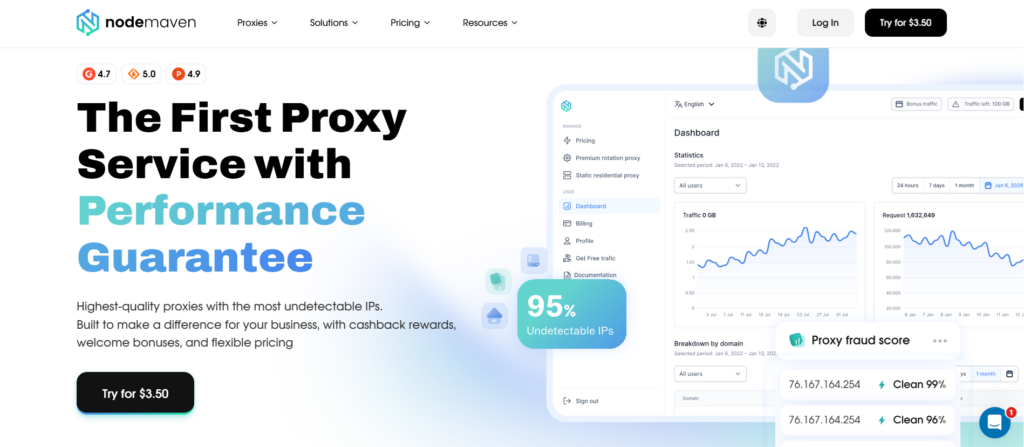
Features like the IP quality filter help you avoid low-reputation IPs before you even start a session. Sticky sessions keep a consistent IP for tasks that need session continuity, like navigating multi-step pages without tripping anti-bot systems. ZIP-level-targeting lets you access region-specific public data accurately, which is useful for market research and localized SEO analysis.
Used together with the practices above, rotating residential proxies help distribute requests naturally, reduce server strain on any single IP, and support scraping that looks and behaves like normal traffic rather than an aggressive bot.
Conclusion
Web scraping legality comes down to a few consistent principles: stick to public data, be careful with anything personal or copyrighted, respect binding contracts you’ve actually agreed to, and scrape at a reasonable pace. Court cases like hiQ v. LinkedIn and Meta v. Bright Data show courts increasingly separate “accessing public data” from “breaking the law”, while still holding scrapers to contracts and privacy rules they’ve accepted.
If your team needs reliable infrastructure for ethical, responsible web scraping, NodeMaven’s residential proxies are built to support exactly that kind of careful, well-paced data collection.
Avoid blocks and collect data more reliably with residential and mobile proxies. Start your NodeMaven trial from $3.50 with 750 MB included


