
How to Track Brand Mentions in AI Search: 2026 Guide


To track brand mentions in AI search, run the prompts your buyers ask in ChatGPT and Gemini, from the countries where those buyers live. Count how often your brand appears, then repeat every week. NodeMaven LLM API automates the whole loop in one request.
A single manual check proves little. AI answers change between runs, between countries, and between the app and the API. This guide shows what to measure, why answers shift, and how to track it all with NodeMaven LLM API in the dashboard or with a short Python script.

Want to see what buyers in other countries see?
Check ChatGPT and Gemini answers by country, region and city with NodeMaven LLM Visibility API
关键要点
- AI answers change by run, by country and by access method. Track mention rate over many runs, not one answer
- Measure mention rate, share of voice, position and citations per engine and per country
- Raw model API answers often differ from what users see in the app. Track rendered answers
- NodeMaven LLM API runs your prompts in ChatGPT and Gemini from the countries and cities you choose, with no cached answers
Is it possible to track brand mentions in AI Search?
Yes, but not like Google rank tracking. ChatGPT and Gemini do not publish rankings. Instead, you send the same questions to each engine many times and count how often your brand appears in the answers.
It matters because buyers now build shortlists inside AI chats. They ask “what is the best tool for X?” and get three or four names back. If your brand is missing, you lose the deal before any click. A brand can even rank first on Google and still be absent from the AI answer. Tracking shows you which prompts you win, which competitors beat you, and how AI describes your product in each market.
How to track brand mention share in AI
Always count across many runs, never from one answer. These four metrics cover what most teams need.
| 指标 | What it shows | How to calculate |
| Mention rate | How often AI names your brand | Answers that name you ÷ all answers |
| Share of voice | Your slice of all brand mentions in your category | Your mentions ÷ mentions of all tracked brands |
| Position | Named first, mid-list or last | Order of first appearance, averaged |
| Citation rate | How often your pages are used as sources | Answers that cite your domain ÷ answers with sources |
*Share of voice (%) = your brand mentions ÷ mentions of all tracked brands × 100
Keep mentions and citations apart. ChatGPT shows sources only when it searches the web, so many answers name brands with no links at all.
Why AI answers mention your brand differently each time
· Brand mentions change from run to run
Each answer is generated fresh. Ask the same question twice and you can get a different list of brands. You need several runs per prompt and a rate, not a screenshot. We saw the same rule in our test of 5,000 Google searches: patterns only show up at volume.
· Track brand mentions by geographic location
AI engines with web search pick sources that fit the user’s location. A buyer in the US and a buyer in Germany can get different brands for the same English prompt. NodeMaven LLM API sets country, region and city per request, so a team in Vienna sees what a buyer in Los Angeles sees.
· Track brand mentions in ChatGPT responses: API vs App
Many tools query the raw model API, not the chat app people use. The answers differ a lot. One independent study found API and app answers shared only 6% to 12% of the brands they named. NodeMaven LLM API renders every answer in a real Chrome session, so your data matches what buyers actually see.
Best ways to track brand mentions in AI Search
These six steps work whether you check answers by hand or with a tool.
1. Collect real buyer questions
Pull them from sales calls, support tickets, Search Console queries and Reddit threads. Write each one as a full question with the buyer’s constraints: “best proxy provider for a small team under $100 a month” beats “best proxy”. Aim for 15 to 30 prompts across four intents:
- 类别: “What are the best residential proxy providers in 2026?”
- 问题: “How do I scrape Amazon without getting blocked?”
- Comparison: “[Brand A] vs [Brand B] for web scraping”
- Alternatives: “What are cheaper alternatives to [Competitor]?”
Keep at least 70% unbranded, since a prompt that names you inflates your score. Once the set is fixed, do not edit the wording.
2. List the brands you will count
Add your brand and three to five competitors, each with aliases, product names, old names and misspellings. A name missing from your list is a mention you never count.
3. Fix engines, locations and session settings
Start with the engines your buyers use most, usually ChatGPT and Gemini. Pick your revenue countries and ask in their language. Use a fresh, logged-out chat for every prompt, since memory and earlier messages change the answer.
4. Run each prompt three to five times
Run the full set in the same time window each week, so model updates are the only big variable.
5. Log and score every answer
One row per answer: date, prompt, engine, country, brands named in order, your position, sources cited. Count a mention only when your brand appears in the answer text. Flag wrong facts, such as old pricing. They are quick fixes on your site.
6. Review weekly and act on gaps
Compare mention rate and share of voice with last week. Then find gap prompts, where a competitor is named and you are not. Open the sources cited in those answers. They show which review sites, listicles and forum threads the AI trusts. Getting listed or quoted there is often the fastest way to win the mention.
By hand, this works for about 10 prompts in one country. Past that, a tracking tool saves hours each week.
How to track brand mentions on ChatGPT
ChatGPT names brands from training data and, when it searches the web, from live pages. Sources appear only during those searches. Mention rate and position are your core metrics here.
How to track brand mentions in Gemini
Gemini gives shorter answers with fewer brands and fewer citations. Log the mention even when no link is shown. With fewer names per answer, each Gemini mention carries more weight.
How to Track Brand Mentions in Perplexity
Perplexity lists sources on almost every answer and often cites a page without naming the brand. Track mention rate and citation rate separately. Track it manually for now. Perplexity support in NodeMaven LLM API is coming soon.
Tools to track brand mentions in ChatGPT and Gemini
You have three options. 手动检测 are free but do not scale. Dashboard tools show charts but often hide how answers are collected. NodeMaven LLM API gives you rendered answers by location, plus the raw data for any report.
| 手动检测 | Typical dashboard tools | NodeMaven LLM API | |
| ChatGPT and Gemini | One at a time | Usually | Both in one request |
| Answer source | Real app | Varies, often raw model API | Rendered in a real Chrome session |
| 位置定位 | Only where you are | Often country only | Country, region and city, up to 10 per API request |
| Raw data | Copy and paste | Varies by plan | Answer text, brands with positions, cited sources, JSON and TXT export |
| 定价 | Your time | Seat or prompt plans | 1 credit per answer, from $0.005 |
Tired of checking AI answers by hand?
Run ChatGPT and Gemini checks in one request. New accounts get 2 free credits
How to Track Brand Mentions With NodeMaven LLM API
Track Brand Mentions in ChatGPT and Gemini From the Dashboard
- Choose engines. Open LLM API (GEO) in the NodeMaven dashboard and select ChatGPT, Gemini or both.
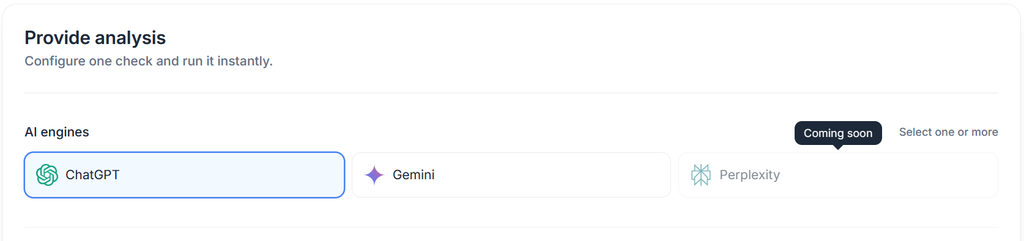
- Pick an analysis type. Niche Monitoring, Solution Selection, Competitor Comparison or Free Analysis.
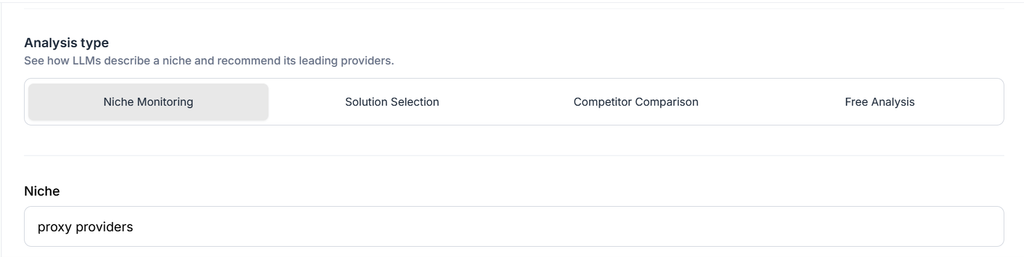
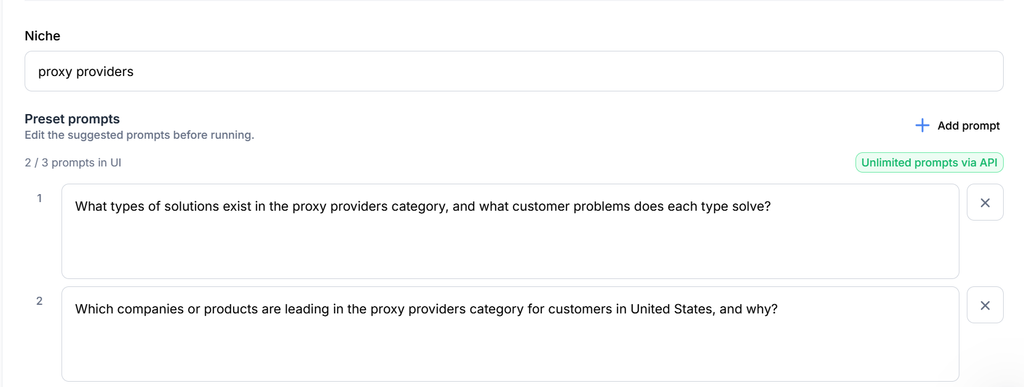
- Enter your niche and edit the prompts. For example, “proxy providers”. Edit the suggested prompts, up to 3 per check.
- Add locations. Add up to 3 countries. Use Advanced settings for region and city. The maximum cost shows before you run.
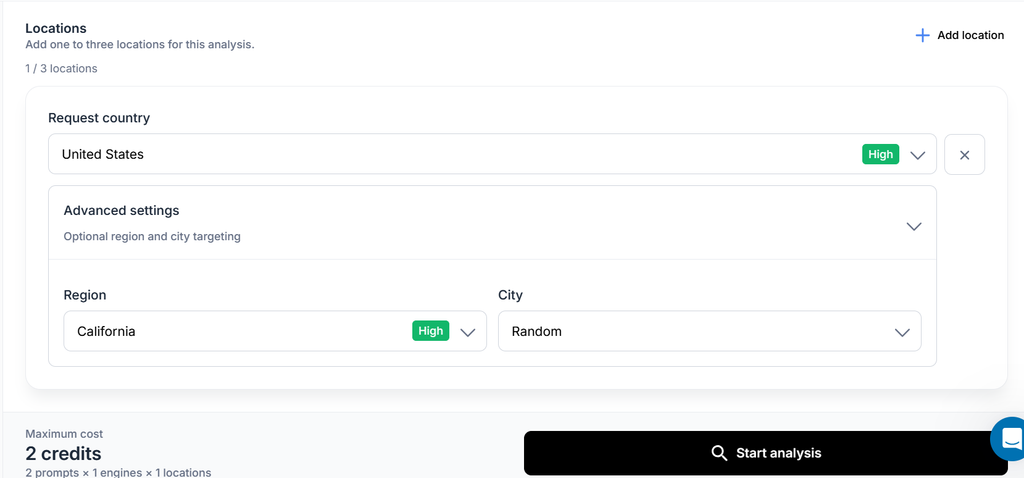
- Run and read the results. Click Start analysis. Each answer takes about 20 to 90 seconds. Switch engines, view the answer or raw JSON, and download TXT or JSON. Copy agent prompt lets your own AI agent set up the same check.
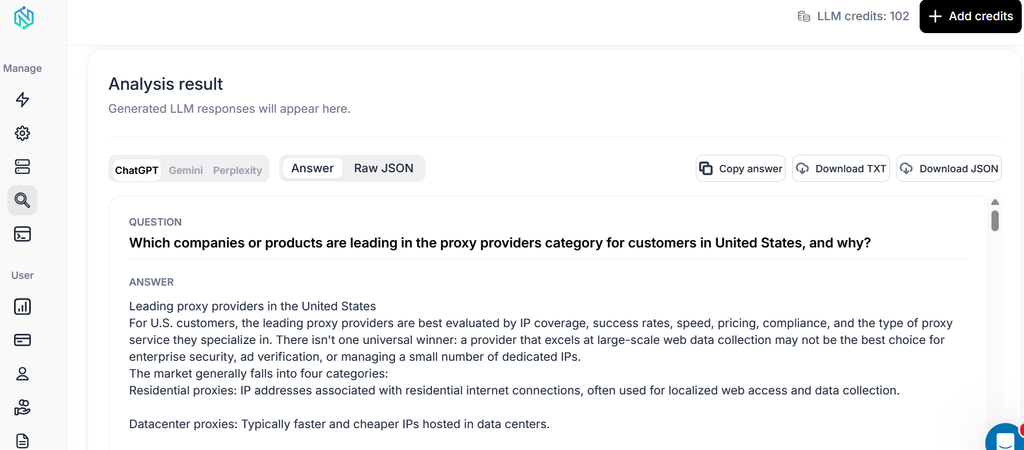
New accounts get 2 free credits. Packs then start at 1,000 credits for $4.99.
Enterprise API for tracking brand mentions in LLMs
The API lifts the dashboard limits: up to 20 prompts and 10 locations per request. Your key is in the dashboard 配置文件. The header prefix is x-api-key, not Bearer. The API unlocks after your first credit pack.
You get a request_id back. Poll GET /api/v2/base/llm/results/{request_id}/ until no row is pending. Each successful row holds the answer in raw_response.text and any sources in raw_response.sources. Full details are in the LLM API docs.
Python script to track ChatGPT brand mentions by country
This script submits your prompts, waits for the answers, saves them to a CSV, and prints mention rate and share of voice per engine and country. For a bigger AI data pipeline, see the best AI web scraping stack in 2026.
Run pip install requests, set NM_API_KEY, and start the script. This example costs 12 credits: 2 prompts × 2 engines × 3 countries.
How marketing teams track brand mentions in ChatGPT every week
Schedule the script with cron or your CI tool on a fixed day. Cost is prompts × engines × locations per run, so budgets are easy to plan.
| 套餐 | Prompts | Engines | 国家 | Credits per run |
| 入门版 | 10 | 2 | 1 | 20 |
| 成长版 | 20 | 2 | 3 | 120 |
| Agency, per client | 20 | 2 | 10 | 400 |
Ready to track your brand every week?
Get 1,000 credits for $4.99 and send ChatGPT and Gemini answers to your reports


