







10 AI Training Jobs Always Hiring in 2026


TL;DR
- Remote AI training jobs pay people to rate, write, label and check data that AI models learn from. Most are freelance and fully remote.
- Entry-level work such as labeling and search rating usually pays $2 to $20 an hour. Rating and writing for chatbots pays roughly $8 to $25. Coding and expert roles can reach $50 to $150 an hour.
- Pay is set by country, so the same task can pay very differently in Lagos, Manila and London.
- In 2026, Stellar AI closed, Toloka moved its contributor work to Mindrift, and Outlier narrowed the list of countries it accepts.
- Using a VPN to fake your location breaks most platforms’ rules and can get your account banned with earnings frozen.
- No real AI training platform asks you to pay to start.
- AI training jobs are legit when you apply through the official site of a known company such as Outlier (Scale AI), Mindrift (Toloka), Alignerr (Labelbox), TELUS Digital or Appen, and nobody asks you to pay.
Remote AI training jobs are one of the most searched ways to earn online in 2026. Deel’s global hiring report named AI training the fastest-growing role on its platform, with cross-border hiring up 283% in 2025. The work is real and remote, and most of it needs no programming skills. Much of the advice online is already out of date, though: some platforms have closed, others stopped accepting certain countries, and “always hiring” rarely means there is always work for you.
Below are 10 remote AI training jobs that keep recruiting in 2026, with what each one involves, its requirements, typical pay and where to apply from your country. After that come payments, scams and a 7-day plan for landing your first paid task. If you want a side-by-side comparison of the platforms themselves, read our guide to the best AI training platforms that pay.
Are AI training jobs really always hiring?
Applications, yes: most platforms accept sign-ups all year because AI companies keep needing human feedback. Paid work is less steady, because each project starts and ends. Being accepted puts you in the contributor pool, and tasks can take days or weeks to show up in your dashboard, so plan for gaps from the start.
What is an AI trainer?
An AI trainer is a person who improves AI models by giving them human feedback: rating chatbot answers, writing example questions and ideal answers, labeling data and correcting mistakes. Most AI trainers work remotely as freelancers through platforms that connect AI companies with contributors, and the work they produce becomes training and testing data for chatbots, search assistants and voice tools.
In practice, AI trainer jobs and AI training jobs are the same thing. Platforms use different titles (AI tutor, rater, annotator, contributor, expert), and the work still falls into the 10 types below.
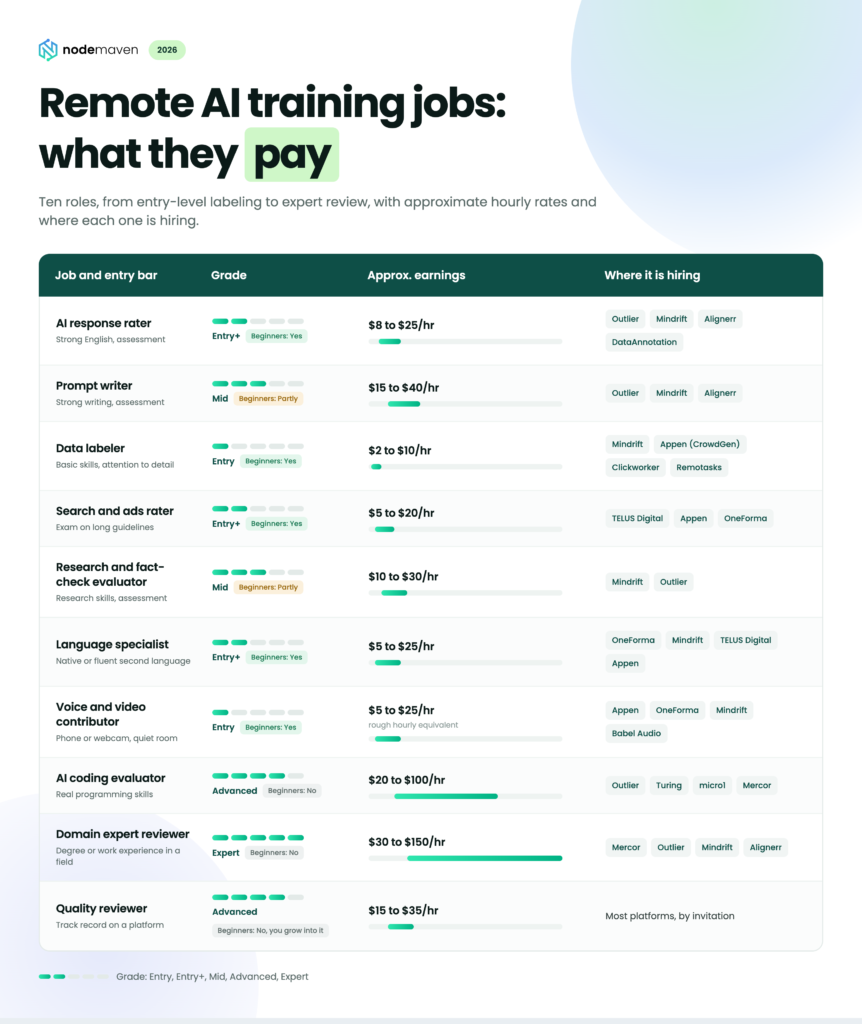
Remote AI training jobs at a glance
| Job | Entry bar | Approx. earnings | 适合新手 | Where it is hiring |
|---|---|---|---|---|
| AI response rater | Strong English, assessment | $8 to $25/hr | 是 | Outlier, Mindrift, Alignerr, DataAnnotation |
| Prompt writer | Strong writing, assessment | $15 to $40/hr | Partly | Outlier, Mindrift, Alignerr |
| Data labeler | Basic skills, attention to detail | $2 to $10/hr | 是 | Mindrift, Appen (CrowdGen), Clickworker, Remotasks |
| Search and ads rater | Exam on long guidelines | $5 to $20/hr | 是 | TELUS Digital, Appen, OneForma |
| Research and fact-check evaluator | Research skills, assessment | $10 to $30/hr | Partly | Mindrift, Outlier |
| Language specialist | Native or fluent second language | $5 to $25/hr | 是 | OneForma, Mindrift, TELUS Digital, Appen |
| Voice and video contributor | Phone or webcam, quiet room | Roughly $5 to $25/hr equivalent | 是 | Appen, OneForma, Mindrift, Babel Audio |
| AI coding evaluator | Real programming skills | $20 to $100/hr | 否 | Outlier, Turing, micro1, Mercor |
| Domain expert reviewer | Degree or work experience in a field | $30 to $150/hr | 否 | Mercor, Outlier, Mindrift, Alignerr |
| Quality reviewer | Track record on a platform | $15 to $35/hr | No, you grow into it | Most platforms, by invitation |
All earnings in this article are approximate. They are based on public listings and contributor reports from 2026, and the rate you see depends on your country, your skills and the project.
10 remote AI training jobs that keep hiring
The 10 most common remote AI training jobs in 2026 are AI response rater, AI prompt writer, data annotator, search and ads rater, research and fact-check evaluator, language specialist, voice and video contributor, AI coding evaluator, domain expert reviewer and quality reviewer. For each one you will find what the work involves, the requirements, typical pay, where it is hiring and how to stand out.
1. AI response rater (AI evaluator)
What you do. You get a question and two or more answers from a chatbot. You decide which answer is better and explain why. Is it accurate and safe? Does it answer the question and follow the instructions? It is the most common AI training job and the easiest to start with.
Requirements. Strong written English, careful reading, and a passed assessment. Most platforms ask for ID verification. Some platforms prefer graduates, but most do not require a degree.
How much you can earn. Roughly $8 to $25 an hour. Generalist rating on Outlier is commonly reported at $15 to $25 an hour in higher-paying regions, while the same work in lower-cost countries often lands in the single digits or low teens. DataAnnotation pays around $20 an hour and up, but only accepts a short list of English-speaking countries.
Where it is hiring. Outlier, Mindrift, Alignerr (see our Alignerr review), DataAnnotation (limited countries).
How to stand out. Write short, specific justifications. “Answer B is better” gets you nowhere. “Answer B follows the word limit and cites the correct year, Answer A invents a statistic” gets you more projects.
2. AI prompt writer
What you do. You write questions or tasks designed to make the AI fail, then write the ideal answer or a grading rubric. Clients want prompts that expose real weaknesses: tricky reasoning, long instructions, niche knowledge.
Requirements. Creative and precise writing, the ability to follow detailed guidelines, and usually a writing assessment. Knowledge of a specific subject raises your rate.
How much you can earn. Usually $15 to $40 an hour. Contributors on Mindrift report up to about $40 an hour for writing tasks, and Outlier lists higher rates when prompts require subject expertise.
Where it is hiring. Outlier, Mindrift, Alignerr.
How to stand out. Use what you know. A prompt about mobile money fees, local tax rules or a regional language is harder for a model and more valuable to the client than another generic riddle.
3. Data annotator and data labeler
What you do. This is what most remote data annotation jobs are. You tag data so models can learn from it: draw boxes around objects in images, label the sentiment of a comment, classify products, mark people, cars or road signs in photos.
Requirements. Basic computer skills, attention to detail and patience. Usually no degree. Some projects have a short qualification quiz.
How much you can earn. Roughly $2 to $10 an hour. Classic microtask work often pays a few cents per item, or $1 to $7 an hour for many people. It is the easiest way into AI training and also the lowest paid.
Where it is hiring. Mindrift (which now hosts the former Toloka tasks), Appen through its CrowdGen portal, Clickworker, and Remotasks where it is still open.
How to stand out. Go for accuracy over speed. Your quality score decides which projects you see next, and a low score means fewer tasks.
4. Search and ads quality rater
What you do. You check whether search results and ads match what a person was looking for. A typical task: here is a query, here are ten results, rate how useful each one is for someone in your country.
Requirements. Good knowledge of your local internet and culture, and a passed exam on long rating guidelines. These roles are often tied to a specific country and language, which is good news if you live outside the US.
How much you can earn. Between $5 and $20 an hour, adjusted by country.
Where it is hiring. TELUS Digital AI Community, Appen (CrowdGen), OneForma. Read our TELUS International AI review before you apply.
How to stand out. Treat the guidelines as exam material, because the qualification test is built on them. Many people fail by skimming a 100-page document.
5. AI research and fact-check evaluator
What you do. You check whether an AI answer is true by researching it online, or you show the AI how to research a topic step by step. Some projects ask you to find sources, compare them and correct the model.
Requirements. Good search skills, a skeptical eye and a passed assessment. Patience matters more than a degree.
How much you can earn. Roughly $10 to $30 an hour. Before it closed, Stellar AI paid a base of $25 an hour for this type of work. Similar projects now run on Mindrift and Outlier.
Where it is hiring. Mindrift, Outlier.
How to stand out. Always add your sources. Reviewers trust a correction with a link far more than one without.
6. Language and localization specialist
What you do. You translate, check translations, rate how natural an AI sounds in your language, or write prompts and answers in it. AI companies need far more data in Yoruba, Tagalog, Bengali, Swahili or Portuguese than they have.
Requirements. Native or fluent level in a second language, plus decent English. Some projects ask for a language test.
How much you can earn. $5 to $25 an hour, depending mostly on the language pair. Rare languages often pay more than common European ones.
Where it is hiring. OneForma, Mindrift, TELUS Digital, Appen (CrowdGen).
How to stand out. List every language and dialect you speak in your profile, including regional ones. A language you think is “too local” may be exactly what a project needs.
7. Voice and video data contributor
What you do. You record your voice reading sentences, have short conversations, or film simple actions on your phone or webcam. This data teaches speech recognition, voice assistants and video models.
Requirements. A smartphone or laptop with a decent microphone, a quiet room, and sometimes a specific accent or language. Usually no degree.
How much you can earn. Usually paid per task or session, which comes to about $5 to $25 an hour on most projects. Some niche conversational audio projects advertise much higher rates. We checked one of them in our Babel Audio review.
Where it is hiring. Appen (CrowdGen), OneForma, Mindrift (video projects), Babel Audio.
How to stand out. Sound quality decides acceptance. Record in a room with soft furniture, keep the phone at the same distance, and listen back before you submit.
8. AI coding evaluator
What you do. You review code written by AI, find bugs, write better solutions, and create coding tasks for models to solve. This is one of the fastest growing areas in AI training.
Requirements. Real programming skills, usually tested with a coding assessment. Python, JavaScript and SQL are common. Some roles ask for proof of experience, such as a GitHub profile.
How much you can earn. Roughly $20 to $100 an hour. Listings on micro1 often sit around $20 to $60 an hour, while senior coding roles on several platforms advertise $70 an hour and more.
Where it is hiring. Outlier, Turing, micro1, Mercor. Read our Mercor 评测 to see how its AI interview works.
How to stand out. When code is wrong, explain why. The reasoning is what clients pay for.
9. Domain expert reviewer
What you do. You use professional knowledge to check AI answers in your field: law, medicine, accounting, finance, engineering, maths, teaching. You also write expert-level questions and rubrics that a generalist could not.
Requirements. A degree or real work experience in the field. Many listings ask for a bachelor’s degree at minimum, and the best paid ones want a master’s or PhD.
How much you can earn. Roughly $30 to $150 an hour. Outlier advertises up to $150 an hour for some expert tracks, Alignerr’s posted roles commonly range from about $35 to $130, and Mindrift lists specialist roles such as mortgage underwriting at up to $50 an hour in several countries.
Where it is hiring. Mercor, Outlier, Mindrift, Alignerr. Students in the US can also look at Handshake AI, covered in our Handshake AI 评测.
How to stand out. Apply for your exact specialty. A nurse who applies to a nursing project gets matched faster than one who applies as a generalist.
10. Quality reviewer
What you do. You check other contributors’ work, give feedback and approve or reject tasks. On many platforms this is the next step after you prove yourself as a regular contributor.
Requirements. A strong track record on the platform: high quality scores, consistency and good guideline knowledge. You usually cannot apply for it; platforms invite you.
How much you can earn. $15 to $35 an hour, usually more than regular contributors earn on the same project.
Where it is hiring. Most platforms promote internally, including Outlier, Mindrift and Alignerr.
How to stand out. Stay on one or two projects long enough to become an expert in their guidelines. People who hop between projects every week rarely get promoted.
What are the requirements for AI training jobs?
Almost every AI training job asks you to be 18 or older, verify a government ID, write good English, pass an assessment, work from a computer with stable internet, and have a payout account that works in your country. The full checklist:
- You are 18 or older and can legally work as an independent contractor in your country.
- A government ID for identity verification, often with a selfie or short video check.
- Good written English, even for many language projects. Some platforms test it directly.
- A passed assessment. On some platforms you only get one attempt, so prepare before you start it.
- A laptop or desktop and stable internet. Many tasks are not practical on a phone, and timed tasks fail if your connection drops.
- A payout account that works in your country, such as PayPal, Payoneer, Airtm or Wise.
- A resume and LinkedIn profile for the better paid platforms, which match you to projects based on your background.
- Honest profile details. Your country, education and languages must match your documents. Mismatches are a common reason for bans.
Which AI training platforms accept international workers in 2026?
Mindrift, Appen (CrowdGen), OneForma and Clickworker accept contributors from the widest range of countries. Outlier, Alignerr and TELUS Digital accept many countries but not all, and DataAnnotation only accepts six English-speaking countries. Country lists change often, so always check the platform’s own page before you apply.
| 平台 | Country access in 2026 | What to know |
|---|---|---|
| Outlier | About 50 to 60 countries | Publishes an official list of countries you can work from (updated July 2026). Several large markets are not on it |
| Mindrift | Broad, global except sanctioned countries | Many roles are tagged to specific countries. Former Toloka tasks now live here |
| Alignerr | 40+ countries | Reported to be closed in a couple of dozen countries |
| DataAnnotation | US, UK, Canada, Australia, New Zealand, Ireland | Do not sign up from elsewhere. Accounts outside the list get closed |
| Appen (CrowdGen) | 100 多个国家 | Each project lists its own eligible countries |
| OneForma | Pays contributors in 100+ countries | Filter open projects by your country |
| TELUS Digital | 30+ countries | Rater roles are tied to specific markets and languages |
| Clickworker | Paid contributors in 140+ countries | Lower pay, but very open |
| Remotasks | Varies | Pulled out of several countries in 2024 and paused new sign-ups in others |
If one platform excludes your country, move on to the next. Mindrift, Appen, OneForma and Clickworker are open to far more countries, and language projects often prefer contributors from exactly the regions that bigger platforms exclude. For a deeper look at each platform, read our guide to 付费 AI 训练平台.
How do AI training platforms pay you?
Most AI training platforms pay through PayPal, Payoneer, Airtm, Wise or bank transfer, weekly or twice a month, once your work is approved. Getting paid can be harder than getting accepted, so check that at least one of these works in your country before you spend time on assessments.
- PayPal. Used by Outlier and many others. Works in most countries, but currency conversion usually takes 2 to 4%. In some countries you can move a PayPal balance to a local mobile money wallet, which adds its own conversion fee.
- Payoneer. Common on Appen, OneForma and Mindrift. A good option where PayPal cannot receive money.
- Airtm. Offered by Outlier and others. Useful in countries with currency restrictions.
- Wise. Supports payouts to 80+ countries and often has better exchange rates.
- Bank transfer. Available on some platforms, usually with a minimum payout.
Two habits save money. Withdraw less often, because fixed fees eat small amounts the most. And keep screenshots of your balance and payout history, because if a platform closes, those records are your only proof of what you were owed.
Can you use a VPN to join an AI training platform?
No. Using a VPN or someone else’s address to join a platform that is closed in your country breaks the rules of Outlier and most other AI training platforms. Platforms check your ID, your payout account and your connection, and those details have to match.
The usual story goes like this: the account works for a few weeks, you complete tasks, and then it is banned with your unpaid balance frozen. That time is better spent on a platform that accepts your country.
Sometimes it goes the other way. Some mobile and home internet providers share IP addresses between many users, and verification systems sometimes flag them as a VPN or proxy by mistake. If a platform keeps rejecting your verification, check how your address looks with a free IP 查询工具 and contact the platform’s support with the result. Our guides on how to look up your IP address 和 WebRTC leaks explain what verification systems can see about your connection.
How much do AI training jobs pay?
AI training jobs pay roughly $2 to $25 an hour for entry-level work such as labeling, search rating and chatbot rating, and $20 to $150 an hour for coding and expert roles. The rate you get depends on your country, your skills and the project. Treat advertised rates as the top of the range. What you take home depends on your rate, the hours you can work and how often tasks are actually available.
Here is a realistic example for a beginner rating chatbot answers:
- Rate: $12 an hour
- Time you can give: 15 hours a week
- Tasks available about 60% of that time
- Result: about $108 a week, or roughly $430 a month
In many countries that is good money, but it is not a stable salary. Dashboards go empty between projects, rates change and tasks get rejected, so experienced AI trainers work on two or three platforms at once. When one goes quiet, another usually has work.
To earn more, move up to better paid roles such as prompt writing, expert review or quality review, and keep your quality score high so platforms invite you to better projects.
What tools do AI trainers need?
You do not need much, but these tools save time and keep your accounts safe:
- A password manager, because you will have accounts on several platforms, payout services and email.
- A separate browser profile for work, so platform logins, extensions and tabs do not mix with your personal browsing.
- A time tracker, so you know your real hourly rate per platform and can drop the ones that do not pay off.
- Backup internet, such as mobile data, for timed tasks.
- Proxies for your other online workflows. If your other projects need clean, stable IP addresses, NodeMaven 住宅代理 和 ISP 代理 give you stable connections from real-user IPs. Use them only where the platform you work on allows it.
How to apply for AI training jobs: a 7-day plan
To apply for AI training jobs, sign up on the platform’s official website, verify your identity, list your skills and languages, pass the assessment for your track, and wait to be matched with a project. The application itself usually takes 30 to 90 minutes. The first paid task can take days or weeks to arrive. This is also how to become an AI trainer with no experience: start with rating, labeling or search evaluation roles, then move up as your quality score grows.
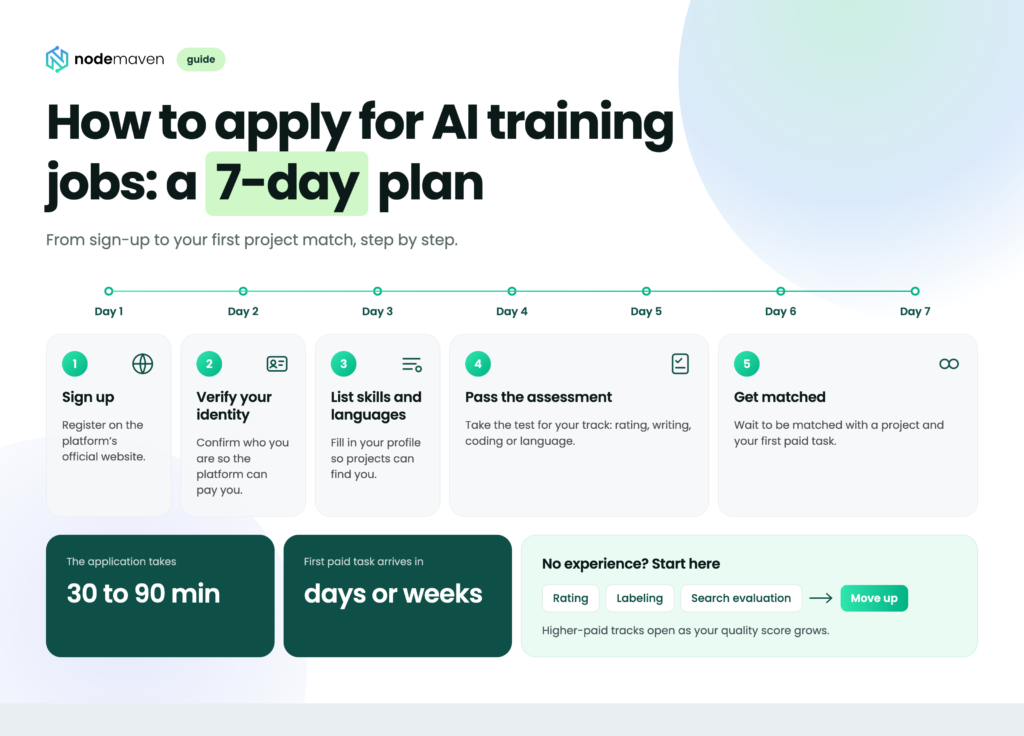
Here is how to fit it into one week:
- Day 1: Pick two roles. Choose one beginner role (rating, labeling, search rating) and one that uses a skill you already have (a language, a profession, coding).
- Day 2: Prepare your documents. A clear photo of your ID, an updated resume in English and a LinkedIn profile that matches it.
- Day 3: Set up payouts. Open or verify PayPal, Payoneer, Airtm or Wise, whichever works in your country, before you apply anywhere.
- Day 4: Check country lists. Confirm on each platform’s official site that your country is eligible. Shortlist three platforms.
- Day 5: Apply to all three. Fill in every skill and language. Profiles with more detail get matched to more projects.
- Day 6: Prepare for assessments. Read the guidelines twice, take notes, and only start a test when you have uninterrupted time.
- Day 7: Take your first assessment. Then keep checking your email and dashboard daily. The first project can take days or weeks to appear.
Are AI training jobs legit?
Yes, most AI training jobs are legitimate. The big platforms are run by real companies, such as Scale AI (Outlier), Labelbox (Alignerr), Toloka (Mindrift), TELUS Digital and Appen, and they pay for approved work through PayPal, Payoneer, Airtm or bank transfer. None of them charge you to join. The risks lie elsewhere: work can dry up without warning, a platform can close or leave your country, and scammers copy well-known names.
| 平台 | 由谁运行 | How it pays | What to know |
|---|---|---|---|
| Outlier | Scale AI | Weekly, via PayPal, Airtm or ACH | Country list narrowed in 2026. Some contractors have publicly complained about withheld earnings |
| DataAnnotation | DataAnnotation.tech | Weekly, via PayPal | Real and paying, but only open to a few English-speaking countries. Usually one attempt at the assessment |
| TELUS Digital AI 社区 | TELUS Digital | Hourly, per approved task volume | Long qualification exams. Roles are tied to specific markets and languages |
| Mindrift | Toloka | Payoneer or PayPal, on a fixed schedule | Rates are set per person and depend on location |
| Alignerr | Labelbox | Per project | Registration does not guarantee paid work. Closed in some countries |
| Appen (CrowdGen) | Appen, in the AI data business since 1996 | PayPal, Payoneer, bank transfer and more | Project availability varies a lot |
Is Outlier AI legit?
Yes. Outlier is operated by Scale AI and pays contributors weekly. The common complaints are empty dashboards between projects, sudden rate changes and country restrictions. Check that your country is on its current list before you apply.
Is DataAnnotation legit, and does it actually pay?
Yes. DataAnnotation pays weekly through PayPal for approved work, with general projects advertised from about $20 an hour. The catch is access: it only accepts people in a short list of English-speaking countries, and accounts created from elsewhere get closed.
Is TELUS Digital legit?
Yes. TELUS Digital is part of the Canadian telecom group TELUS, and its AI Community has hired search and ads raters for years. Read our TELUS International AI review for pay and exam details.
How to check any AI training platform in two minutes
- The company behind it is named in its Terms of Service.
- You found it on its official domain, not through a chat message.
- It never asks for a fee, a deposit or your card details.
- Recent reviews on Reddit and Trustpilot mention real payouts.
- It names its payment methods before you start working.
How to spot AI training job scams
The clearest sign of an AI training job scam is a request to pay before you earn: a fee, a deposit or your card details. Other warning signs:
- A fee to start. A “registration fee”, “training fee” or “security deposit” to unlock tasks. Legitimate platforms never charge you to unlock work. The US Federal Trade Commission lists upfront fees as a classic sign of job scams.
- Accounts for sale or rent. People sell “verified” accounts on platforms closed in your country. The account is not in your name, so you cannot withdraw safely, and it gets banned when the platform notices.
- Recruiters in Telegram or WhatsApp. Real platforms recruit through their official sites and job pages, so treat a stranger in a chat promising $50 an hour as a scam.
- Lookalike websites. Fake pages copy the design of well-known platforms. Type the address yourself or open it from the platform’s official social accounts.
- Requests for card details or crypto. Nobody needs your card number to pay you.
What changed in AI training jobs in 2026?
Five changes in 2026 that many older guides still miss:
- Stellar AI has closed. In October 2026 its homepage switched to a “Stellar AI is closing” notice. Existing contractors can still log in to request their remaining balance.
- Toloka moved to Mindrift. Toloka and Toloka Annotators tasks now live on Mindrift, and accounts moved automatically. Do not create a second account. Our Toloka AI review explains the change.
- Outlier narrowed its country list. Its July 2026 guidelines left out several countries that used to send many contributors, so check the current list before applying.
- Remotasks is still closed in several countries. It left several markets in 2024 and has not reopened there.
- Expert work is growing faster than microtasks. The best rates have moved to people with provable skills in coding, science, law, medicine and languages, while simple labeling pays less than before.
关键要点
- Remote AI training jobs are real and paid, and many are open to people outside the US and Europe.
- They work best as flexible side income, because task availability changes week to week.
- Start with one beginner role (rating, labeling or search rating) and one role that uses a skill you already have.
- Confirm the platform accepts your country and that you can get paid before you invest time.
- Join two or three platforms so one empty dashboard does not stop your income.
- Never pay to start, and never fake your location to get in.
- The highest earners read the guidelines properly, keep quality high and move up from rater to writer, reviewer or expert.


